
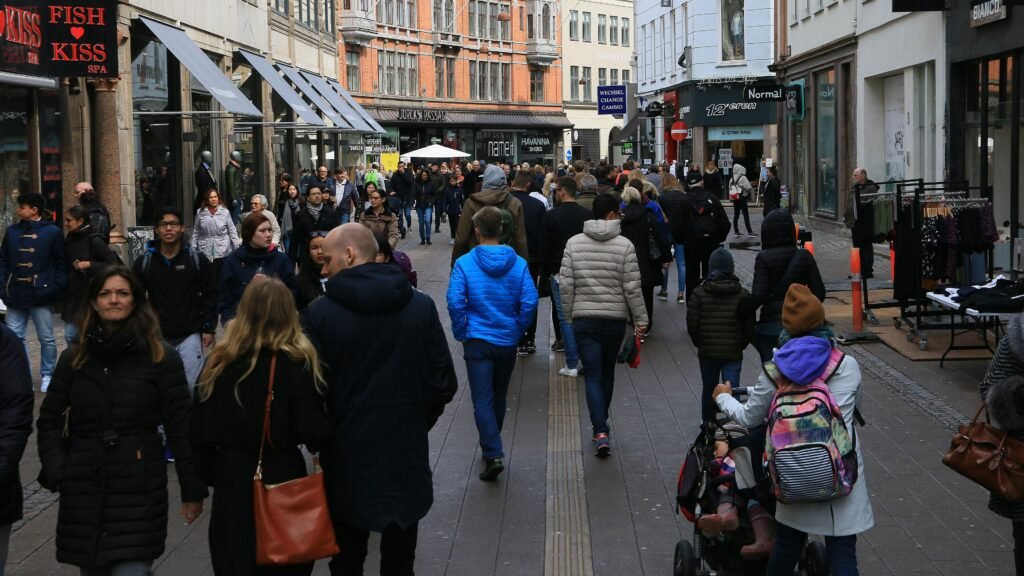

Europe’s highest-scoring published city guides do not share one urban form. Copenhagen leads through a broad, connected center reinforced by bridges and strong public transport. France and the Netherlands each place three cities inside the large second-place tie, but for different reasons. Haarlem and Utrecht emphasize compactness and station proximity, while Paris succeeds at a much larger scale. Florence proves a dense historic core can compete despite crowds and rough surfaces. Madrid and Munich stretch farther, yet keep major visitor districts connected. This ranking covers the 100 European city guides currently published by Walkable Weekend, not every city on the continent.
Europe’s 12 Highest-Scoring Published Cities
Copenhagen is the only city at 95/100. Eight cities share 94/100 and therefore share second place. Florence, Vienna and Zurich each score 93/100 and share tenth. The table uses T-2 and T-10 to keep those ties visible; alphabetical order inside each tie is only for readability.
| Rank | City | Country | Overall score | Strongest walking advantage | Main limitation |
|---|---|---|---|---|---|
| 1 | Copenhagen | Denmark | 95/100 | Broad connected center, flat walking and harbor bridges backed by deep transit | Outer districts separate from the core; cycle crossings, cobbles and crowds add friction |
| T-2 | Amsterdam | Netherlands | 94/100 | Dense canal core with strong transit and easy car-free arrival | Bridge detours, busy cycle lanes, tram tracks and crowds complicate some short walks |
| T-2 | Bordeaux | France | 94/100 | Flat historic center, long pedestrian axis and connected Garonne quays | Chartrons and especially Cité du Vin extend beyond the tightest central footprint |
| T-2 | Haarlem | Netherlands | 94/100 | Exceptionally compact station-to-Grote Markt historic core | The visitor footprint is smaller and local transit matters less once the core ends |
| T-2 | Madrid | Spain | 94/100 | Royal Palace, Sol, Gran Vía, Paseo del Arte and Retiro form one broad visitor belt | The central footprint is large, with crowds and major junctions increasing effort |
| T-2 | Munich | Germany | 94/100 | Strong Altstadt pedestrian spine with excellent transit for wider districts | Maxvorstadt, the English Garden and outer palaces widen the weekend footprint |
| T-2 | Paris | France | 94/100 | Dense central neighborhoods connect across the Seine, with exceptional transit depth | Overall scale, major avenues, crowds and Montmartre elevation make some days demanding |
| T-2 | Strasbourg | France | 94/100 | Grande Île and Neustadt create a compact, mostly flat and legible walking network | The European Quarter sits apart from the core, and historic surfaces add localized friction |
| T-2 | Utrecht | Netherlands | 94/100 | Compact Oudegracht core sits close to Utrecht Centraal and connects cleanly on foot | Wharf stairs, level changes and busy cycling interfaces add vertical and crossing friction |
| T-10 | Florence | Italy | 93/100 | Exceptionally dense historic core keeps most major sights within consecutive walks | Crowds, uneven stone, narrow streets and the climb toward Piazzale Michelangelo add effort |
| T-10 | Vienna | Austria | 93/100 | Inner City and Ring form a strong central walk, with excellent transit to outer sights | Schönbrunn, Prater and other major destinations are genuine separate clusters |
| T-10 | Zurich | Switzerland | 93/100 | Zürich HB, Bahnhofstrasse, the Limmat, Old Town and lake form a compact central chain | The eastern Old Town climbs and Zurich West is a separate transit-supported extension |
Why Copenhagen Leads
Copenhagen wins through connected scale rather than tiny geography. København H, Tivoli, City Hall Square, Strøget, Christiansborg, Kongens Nytorv, Nyhavn and Amalienborg form one broad sightseeing chain. Round Tower and Rosenborg are short northern branches, while harbor bridges shorten routes toward Christianshavn.
The core still has real edges. Kastellet and the Little Mermaid extend the northern walk, while Frederiksberg and much of Nørrebro are separate districts. Cycle-lane crossings, cobbles and central crowds also require attention, even where the pedestrian network is excellent.
Current operator information still says the Copenhagen Metro runs every day and night. That makes outer districts unusually easy to add without turning the best central walking hours into transit time. The Denmark ranking shows how Copenhagen’s broad network differs from the country’s smaller, tighter walking cities.
Second Place Is an Eight-City Tie
The 94-point group is too close to force into an artificial order. Amsterdam, Bordeaux, Haarlem, Madrid, Munich, Paris, Strasbourg and Utrecht therefore share second place. Their totals match, but the practical reasons for choosing them are very different.
France: Bordeaux, Paris and Strasbourg
Bordeaux is the most linear of the French trio. The historic center opens onto long Garonne quays, while Rue Sainte-Catherine provides a roughly 1.2-kilometer pedestrian axis through the core. Chartrons remains a natural extension, but Cité du Vin sits farther beyond the tightest first-time footprint.
Paris reaches the same total from a completely different scale. The Louvre, Île de la Cité, the Marais and the Left Bank connect through a dense central network, while the Seine helps orientation. Montmartre, major avenues and the overall size of the city make a full weekend more demanding, so the Metro matters much more than in Bordeaux.
Strasbourg sits between those patterns. Grande Île concentrates the cathedral, squares and historic streets inside a compact island center, with Neustadt extending the walk naturally. The European Quarter is a genuine separate cluster, so trams become useful after the central pedestrian geography is already exhausted.
The France ranking explores the contrast in more detail: Bordeaux and Strasbourg emphasize flatter, tighter visitor geography, while Paris relies more heavily on transit to support its much larger sightseeing network.
Netherlands: Amsterdam, Haarlem and Utrecht
Amsterdam combines a compact canal core with a larger set of nearby visitor districts. Museumplein, De Pijp and Plantage are close enough to connect selectively, yet the best route often depends on bridges and tram corridors. Busy cycle lanes, tram tracks and crowds create more pedestrian friction than the city’s flat terrain suggests.
Haarlem is the small-city counterpoint. The railway station sits about a ten-minute walk from Grote Markt, and most first-time sights cluster around the historic center and Spaarne. Local transit matters less because the main weekend rarely needs to leave that compact footprint.
Utrecht also compresses sightseeing around one clear center. Oudegracht, Domplein and the museum quarter sit close to Utrecht Centraal, but the canal wharves create a second pedestrian level. Stairs, cycling interfaces and the station-to-center mall transition add small complications to otherwise direct routes.
The Netherlands ranking makes the Dutch tradeoff especially clear. Amsterdam offers the broadest visitor variety, while Haarlem and Utrecht deliver more compact central walking with less need for local transit.
Munich and Madrid: Large Centers That Stay Coherent
Munich anchors the weekend around a roughly one-kilometer pedestrian spine between Karlsplatz and Marienplatz. The Altstadt stays compact and legible, while Maxvorstadt and the English Garden widen the useful walking area. Excellent rail, U-Bahn and tram coverage makes those wider districts easy to add without changing their actual distance from the center.
The Germany ranking shows why Munich leads its national group: it combines a strong central pedestrian environment with unusually deep transit for the extensions that sit beyond the Altstadt.
Madrid spreads farther but preserves a continuous visitor belt. The Royal Palace, Plaza Mayor, Puerta del Sol, Gran Vía, Paseo del Arte and Retiro can be linked across a long central day. Crowds, major junctions and the sheer length of that belt increase effort, while the Metro is most valuable for neighborhoods beyond it.
The Spain ranking places Madrid’s broad connected center against smaller or differently shaped Spanish city breaks, where compactness and terrain create another balance.
Tenth Place Is a Three-City Tie
Florence, Vienna and Zurich each score 93/100 and share tenth place. One point separates them from the eight-city second-place tie, but their walking experiences again differ more than the totals suggest.
Florence has one of the densest historic sightseeing footprints in the ranking. Santa Maria Novella, the Duomo, Piazza della Signoria, Ponte Vecchio and much of Oltrarno fit into consecutive walks. Crowds, uneven stone and narrow streets slow those short distances, while Piazzale Michelangelo introduces the clearest climb. The Italy ranking shows how strongly Florence benefits from concentration.
Vienna works at a broader scale. The Inner City and Ring connect major first-time sights on foot, but Schönbrunn, Prater and other important destinations are genuine separate clusters. Trams and U-Bahn service make those extensions easy without pretending they belong to one continuous central walk. The Austria ranking provides the national comparison.
Zurich begins unusually well at Zürich HB. Bahnhofstrasse, the Limmat, both sides of the Old Town and the lake form a compact central chain, while the eastern Old Town adds short climbs. Zurich West is a separate transit-supported extension. SBB currently lists multiple direct long-distance services between Zürich Airport and Zürich HB, reinforcing an already easy car-free arrival. The Switzerland ranking compares Zurich with the country’s other published guides.
What Separates Cities This Close?
Compactness is only one part of the traveler experience. Haarlem and Florence keep more sightseeing inside a small historic footprint, while Paris, Madrid, Munich and Vienna offer broader city breaks that benefit from stronger transit at the edges. Copenhagen combines both patterns better than any other currently published European guide.
Surface conditions also change how short distances feel. Florence’s stone streets, Amsterdam’s cycle-lane crossings and Utrecht’s wharf stairs create different kinds of friction. Bordeaux and Strasbourg feel flatter and more linear, while Zurich’s eastern Old Town and Florence’s southern viewpoints introduce more noticeable climbing.
Water can either organize a route or complicate it. Bordeaux’s quays, Paris’s Seine and Zurich’s Limmat provide clear orientation. Amsterdam and Utrecht use canals as defining visitor geography, but bridge placement and multiple levels can make the shortest map distance less direct on foot.
Best Fit by Traveler Priority
| Traveler priority | Best fit | Why |
|---|---|---|
| Best all-around walk-first city break | Copenhagen | The strongest combination of connected central sightseeing, pedestrian conditions, transit and easy arrival. |
| Smallest-feeling historic core | Haarlem and Florence | Both keep a very large share of first-time sightseeing inside short consecutive walks. |
| Best big-city variety without a car | Paris, Madrid, Munich and Vienna | Each offers a broad visitor footprint with strong transit once the central walking area ends. |
| Best canal or river-led walking | Amsterdam, Utrecht, Bordeaux, Paris and Strasbourg | Waterways structure useful visitor routes rather than acting only as scenery. |
| Easiest flat central walking | Copenhagen, Bordeaux, Strasbourg, Haarlem and Munich | Their main first-time walking areas avoid sustained climbs, though surface and crowd friction still varies. |
| Best for minimizing local transit | Haarlem and Florence | Most standard first-time sightseeing can be linked on foot after arrival. |
| Best for transit-backed outer districts | Copenhagen, Paris, Amsterdam, Madrid, Munich and Vienna | Transit is especially useful when the itinerary expands beyond a strong central walking network. |
Current Transit Context for 2026
Current operator information supports several useful planning details. Copenhagen’s Metro says it runs every day and night. RATP shows Metro line 14 serving Aéroport d’Orly directly. SBB lists multiple direct long-distance trains from Zürich Flughafen to Zürich HB. Day-of maintenance, closures and strikes can still change individual journeys, so check the relevant operator near departure.
How to Use This Ranking
A one-point difference should not outweigh travel style. Choose Haarlem or Florence when short consecutive walks matter most. Pick Paris, Madrid, Munich or Vienna when you want metropolitan variety and are comfortable using transit selectively. Amsterdam and Utrecht suit travelers who enjoy canal geography and can manage busy cycling interfaces. Bordeaux and Strasbourg are especially strong for flatter, more linear days.
Copenhagen remains the most complete package in the current published set, but the large second-place tie is the more important planning story. Eight cities reach the same total through different combinations of compactness, pedestrian comfort, transit usefulness and arrival convenience.
Seasonal Comfort Still Changes the Pace
Heat, rain, wind, winter darkness and crowd levels can change how comfortable the same route feels. Waterfront exposure matters in Copenhagen, Bordeaux, Amsterdam and Zurich, while summer heat can make Madrid and Florence more tiring. These conditions affect pacing and clothing without changing the underlying street, distance and transport relationships.
Bottom Line
Copenhagen is the sole leader among Walkable Weekend’s currently published European city guides. The eight-way tie behind it includes compact cities such as Haarlem and Strasbourg alongside metropolitan heavyweights such as Paris, Madrid and Munich. Florence, Vienna and Zurich sit only one point back, each with a very different balance of concentration, terrain and transit. For a two- or three-day trip, the best choice depends less on the tiny score gaps than on the kind of walking weekend you want.