
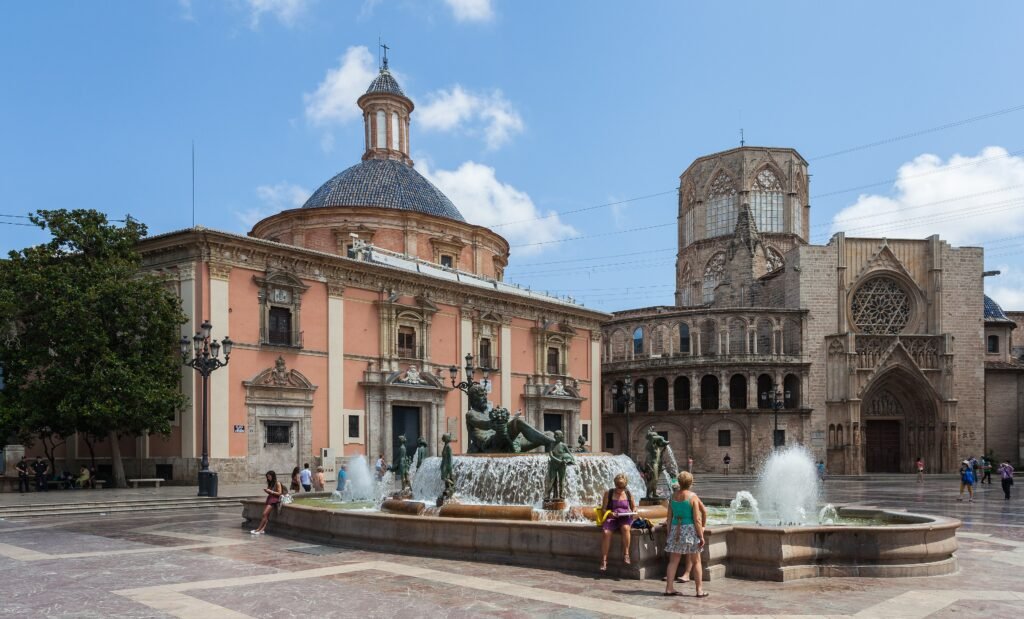
Valencia links a dense medieval center to newer districts through a remarkably legible green spine. Ciutat Vella concentrates the Cathedral, Central Market, Silk Exchange, and major squares within a compact pedestrian network. South of the center, Ensanche and Ruzafa add wider sidewalks, shops, restaurants, and straightforward streets. The Turia Gardens then provide nine car-free kilometers beside the historic core and toward the City of Arts and Sciences. Valencia is also notably flat, keeping walking effort low across most visitor routes. The beach remains a separate eastern cluster, so one transit hop can save substantial time.
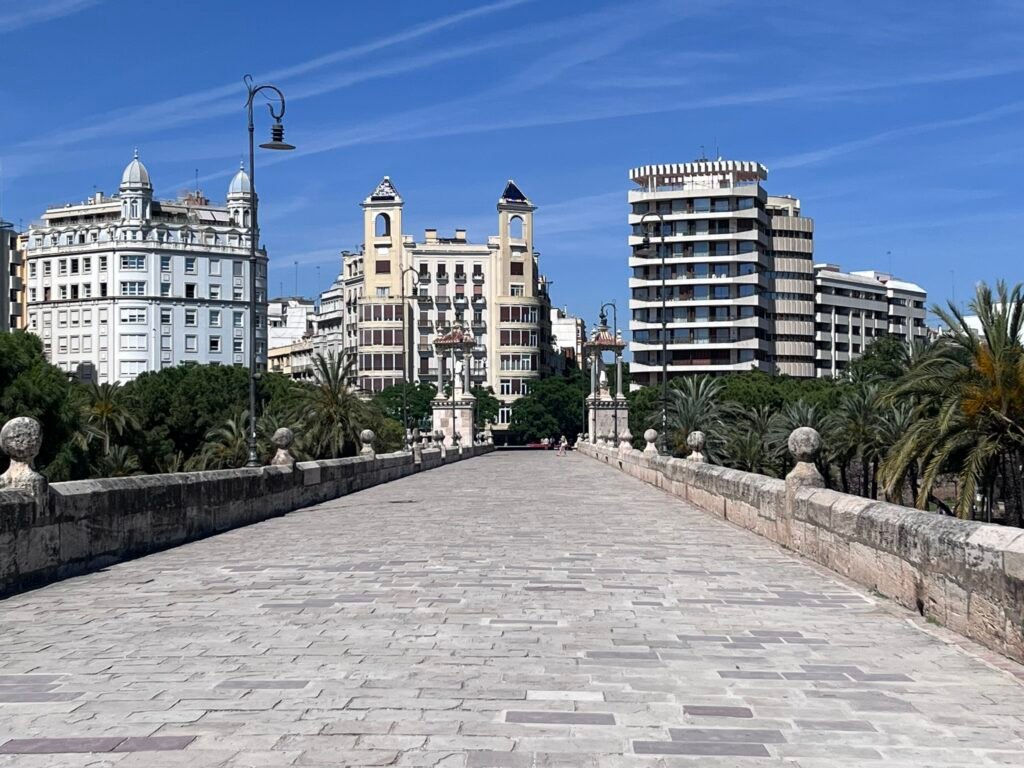
Why Valencia Works So Well on Foot
Valencia’s strongest walking advantage is concentration. The Cathedral, Central Market, Silk Exchange, Plaça de la Verge and civic center sit within one compact central network. Official visitor routes already treat the historical center as a walking itinerary, and the short distances mean transit usually adds more friction than value inside Ciutat Vella.
The second advantage is what happens when the old town ends. Ensanche and Ruzafa continue south with more regular streets, broad sidewalks and dense cafés, shops and markets. This prevents the visitor experience from collapsing into one small monument district.
The Turia Gardens change the east-west geography even more. The former riverbed creates about nine kilometers of continuous green space beside central Valencia and toward the City of Arts and Sciences. Walking here feels like part of the visit rather than a transfer along a busy arterial.
Terrain rarely works against you. Valencia is notably flat, and official accessibility guidance describes most Turia routes as level or without major elevation changes. Over a full weekend, that matters: distance is usually the limiting factor, not climbing.
Best Areas to Stay for a Walking Weekend
Ciutat Vella and Sant Francesc: best for first-time sightseeing
A base around Plaça de la Verge, the Central Market or Plaça de l’Ajuntament minimizes the need for transport. The old town’s major monuments, markets and squares become short walks, while Estació del Nord and the southern districts remain close.
Ensanche and Colón: the best all-round compromise
Ensanche sits between the historic center, Ruzafa and the Turia. Streets are broader and easier to read than the medieval core, while Mercado de Colón, shopping and restaurants keep daily errands inside the neighborhood. It is especially practical for travelers who want central access without sleeping in the busiest old-town lanes.
Ruzafa: strongest for evenings and neighborhood atmosphere
Ruzafa extends the walkable central area south of Estació del Nord. Restaurants, bars, shops and the neighborhood market make it easy to finish a walking day without commuting elsewhere for dinner. The trade-off is a slightly longer morning walk to the Cathedral and northern Ciutat Vella.
City of Arts or the beachfront: choose them for a specific priority
Staying beside the City of Arts and Sciences works when the modern complex, Oceanogràfic or Turia is a major priority. Cabanyal and Malvarrosa make sense for a beach-first trip. Neither location is as efficient for repeated historic-center sightseeing as a central base.
Realistic Walking Times
Central Valencia is compact enough that many headline connections fit inside 5–15 minutes. The important change comes when the route reaches the eastern visitor areas. These are planning estimates rather than guaranteed navigation times; signals, crowds and chosen park paths can change them.
- Torres de Serranos to Plaça de la Verge: about 5–7 minutes.
- Plaça de la Verge to La Lonja and Central Market: about 8–10 minutes.
- Central Market to Plaça de l’Ajuntament: about 8–10 minutes.
- Plaça de l’Ajuntament to Estació del Nord: about 5–7 minutes.
- Estació del Nord to Mercado de Colón: about 12–15 minutes.
- Mercado de Colón to Mercat de Russafa: about 12–15 minutes.
- Ciutat Vella to the City of Arts and Sciences: roughly 35–45 minutes, depending on the starting point.
A 2-Day Valencia Walking Route
Day 1: Ciutat Vella, civic center and Ruzafa
Walking route
Day 1: Ciutat Vella, civic center and Ruzafa
- Torres de Serranos
- Plaça de la Verge
- Valencia Cathedral
- La Lonja de la Seda
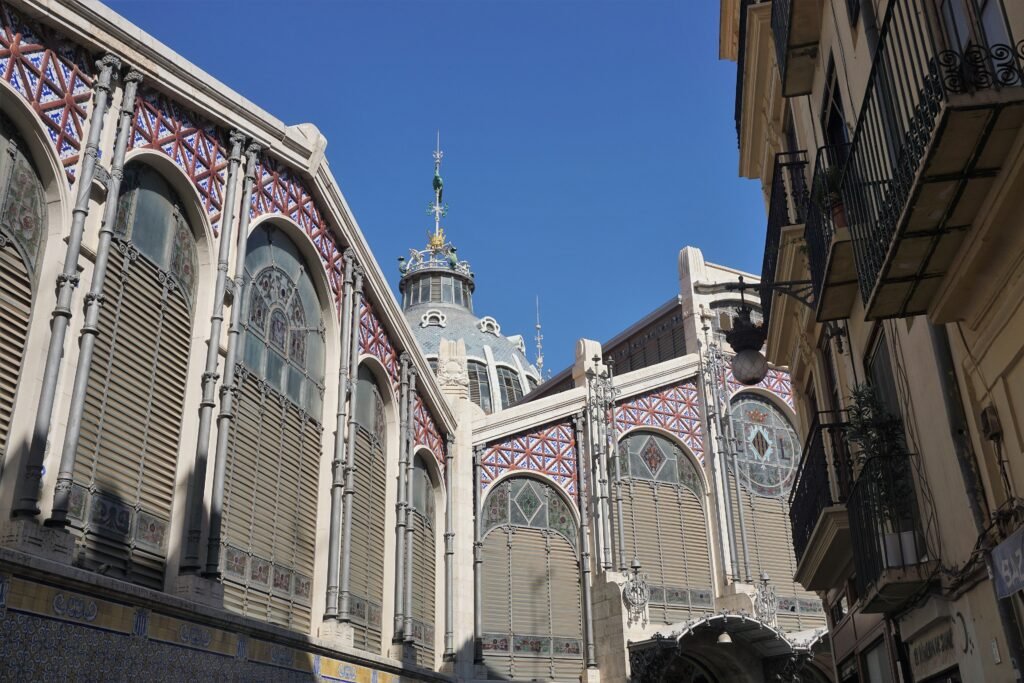
- Mercado Central de València
- Plaça de l'Ajuntament
- Estació del Nord
- Mercado de Colón
- Mercat de Russafa
Start at Torres de Serranos and move south through Valencia rather than circling the same old-town streets repeatedly. Plaça de la Verge and the Cathedral form one compact first cluster. From there, La Lonja and Central Market sit almost opposite each other, making the market district unusually efficient for sightseeing.
Continue to the pedestrianized Plaça de l’Ajuntament and Estació del Nord. The route then changes character: broad Ensanche streets lead to Mercado de Colón before the day finishes around Mercat de Russafa. Ending in Ruzafa avoids a low-value return walk and puts restaurants and evening activity around you.
Day 2: Viveros and the Turia Gardens to the City of Arts
Walking route
Day 2: Viveros and the Turia Gardens to the City of Arts
- Museu de Belles Arts de València
- Jardins del Real (Viveros)
- Pont del Real / Turia Gardens
- Palau de la Música
- Gulliver Park
- Palau de les Arts Reina Sofía
- Hemisfèric
- Museu de les Ciències
- Oceanogràfic
Begin near the Museu de Belles Arts and Jardins del Real, then drop into the Turia Gardens around Pont del Real. From here, the former riverbed does the navigation work. Follow it east past the Palau de la Música and Gulliver Park instead of using parallel traffic streets.
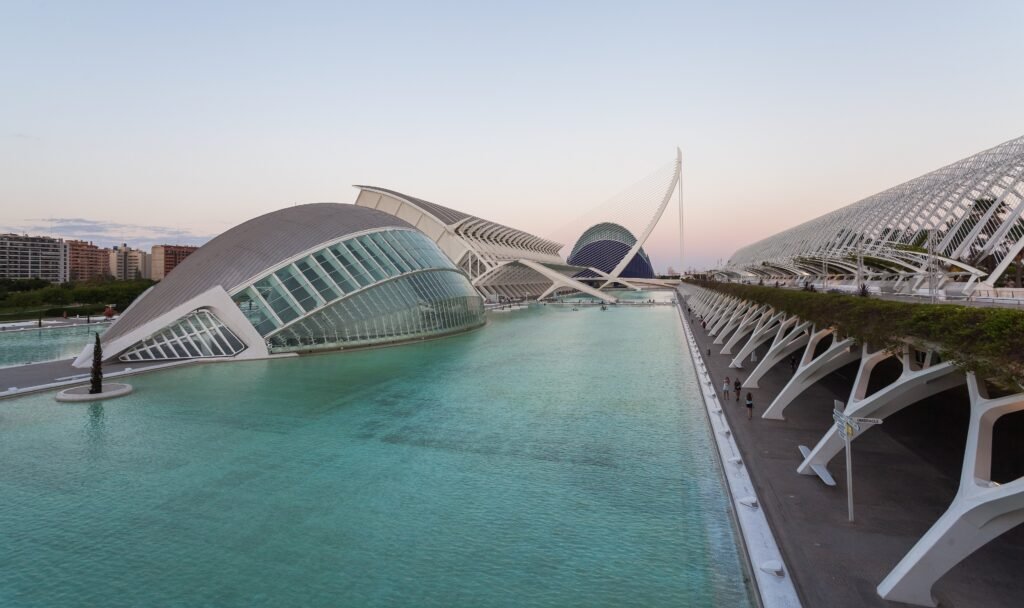
The route finishes inside the City of Arts and Sciences. Palau de les Arts, Hemisfèric, the Science Museum and Oceanogràfic are close enough to link on foot, but the complex is physically large. Choose interiors selectively: Oceanogràfic alone can occupy several hours. Return by transit rather than walking the entire Turia route backward.
Public Transit: When It Actually Helps
Walking should handle most movements inside Ciutat Vella, Sant Francesc, Ensanche and Ruzafa. Transit becomes valuable when the walk stops adding sightseeing value. The beachfront is the clearest example, while the City of Arts and Sciences is a judgment call: the Turia walk is excellent once, but not every traveler wants to repeat it.
Metrovalencia and trams cover major corridors, and Line 10 serves the City of Arts and Sciences area. EMT buses fill gaps, including trips that do not align neatly with rail. Integrated SUMA products can cover multiple operators, while the Valencia Tourist Card bundles transport for travelers who will use it enough.
Arriving in Valencia Without a Car
Valencia Airport is unusually easy for a car-free city break. Aena lists Metro lines 3 and 5 from the airport, with the station on the ground floor of the terminal. Both connect directly with central Valencia. Published frequency is about every 15 minutes on workdays and about every 20 minutes on weekends and holidays.
Rail arrival is similarly straightforward. Estació del Nord opens directly into the central city beside Plaça de l’Ajuntament. Joaquín Sorolla handles high-speed services about 800 meters farther south and has an onward connection to the Nord station area. Neither arrival requires a rental car for a normal central stay.
Main Walking Limitations
Valencia’s weakness is not a broken pedestrian core; it is the width of the full visitor map. The beach, Marina and Cabanyal sit far enough east that walking from Ciutat Vella becomes low-value transfer mileage. Treat the maritime side as its own cluster and arrive by tram, Metro or bus.
The City of Arts and Sciences creates a smaller version of the same issue. The Turia Gardens make the approach pleasant, but the complex itself stretches for more than two kilometers. Museum interiors then add additional walking, so a park day can become longer than the map suggests.
Inside Ciutat Vella, short distance does not mean every surface is perfect. Medieval lanes can be narrow, and historic paving or street furniture can reduce passing space. The main central squares and pedestrian zones are much easier, but travelers with mobility concerns should still plan routes rather than relying only on straight-line distance.
The Turia Gardens are a major pedestrian asset, yet bicycles use parts of the same corridor or cross pedestrian routes. Stay aware at shared or intersecting paths.
When a Car Becomes Useful
A private car adds little to the standard two- or three-day Valencia city break. Central parking and road navigation do not improve the short walks that define Ciutat Vella, and public transport already covers the airport, City of Arts and Sciences and beachfront.
A car becomes more useful when Valencia is one stop in a wider regional itinerary with several rural, coastal or inland destinations that are awkward to combine by public transport. Even then, common excursions should be checked individually before renting. For example, public buses can reach the Albufera area, so a car is not automatically necessary for that side trip.
Practical Walking Tips
Use the Turia strategically. Walking its eastern section is worthwhile when the park is part of the day; repeating the same long corridor purely to return to a hotel is not. The same principle applies to the beach: use transit to position yourself, then walk locally along the waterfront and Cabanyal.
Central Market closes earlier than many attractions, so put it in the morning or early afternoon. Timed attractions at the City of Arts and Sciences can also determine Day 2 order. Build the route around fixed entry times rather than crossing the city twice.
During Fallas, normal street conditions change dramatically. Monument installations, crowds and traffic restrictions can alter walking lines and surface transport.
Seasonal Walking Note
Valencia’s flat terrain and connected central districts remain practical for walking throughout the year. Summer heat can make long exposed walks less comfortable at midday, while autumn and late winter bring more rain. In hotter periods, shift the Turia and beachfront walking to morning or evening and use museums, markets or transit during the warmest hours.
Bottom Line
Valencia fits a walking-first weekend exceptionally well because the most valuable central sights connect before transit becomes necessary. Ciutat Vella, Sant Francesc, Ensanche and Ruzafa can fill a full day with short, interesting walks. The Turia Gardens then provide a memorable second-day route to the modern eastern landmarks. Save public transport for the beachfront, repeat cross-city movements and the return from long park walks, and a private car becomes unnecessary for the standard city break.