


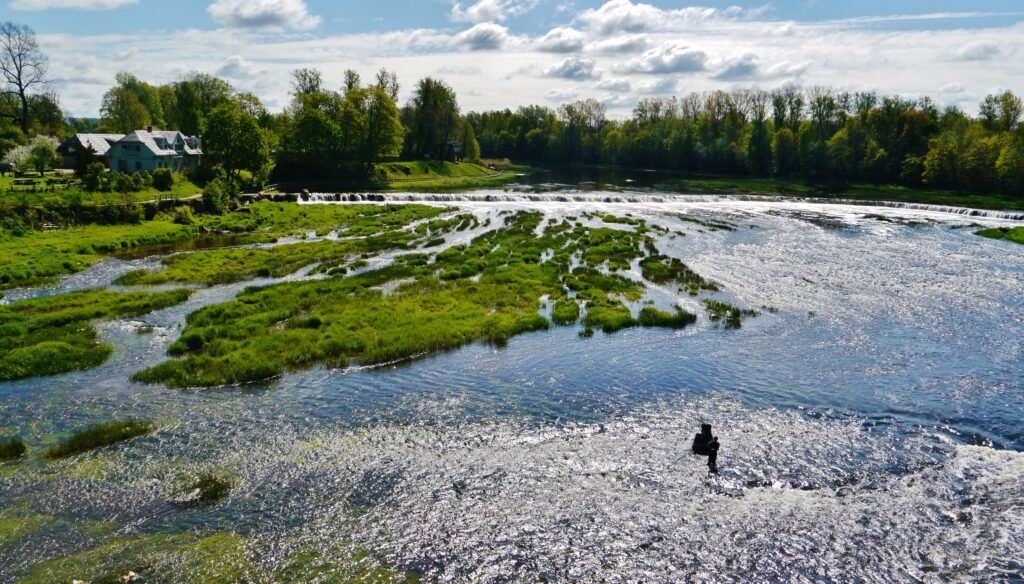
At Kuldīga, the old street plan reaches the water before the walking day becomes long. Baznīcas Street runs east from Town Hall Square through timber buildings and Alekšupīte crossings toward the Venta. The river then brings the waterfall and 1874 brick bridge into the same central visitor area. These sights can be combined within a few kilometers, without a bus ride between districts. However, historic cobbles and narrow shared streets complicate routes that look effortless on a map. The town’s strongest pedestrian circuit stays near the old center; longer Venta trails and rural attractions belong to separate plans.
Why Kuldīga Works on Foot
Kuldīga’s visitor attractions are unusually close, not merely contained within one municipality. Town Hall Square anchors the old center at Baznīcas iela 5. The same street leads through wooden buildings and crossings over Alekšupīte toward St. Catherine’s Church and the waterfall. The old brick bridge and the Venta Rapid lie just beyond this street sequence. A typical visitor can connect the headline sights in one unhurried pedestrian circuit, then return to a centrally located room without using public transportation.
The UNESCO designation recognizes preserved urban form, not a modern traffic-free network. Sidewalk widths change, vehicles use some historic streets, and cobblestones can slow walking. The core still functions well for a visitor who is comfortable on mixed surfaces. For a longer outing, the left-bank Venta path provides a separate waterside option; it is not needed to reach the headline sights.
Where Walking Takes More Effort
The most meaningful difficulty is underfoot rather than geographic. Uneven cobbles, stone paving and short steps can make a five-minute walk feel longer with a stroller or rolling suitcase. Some riverbank access is gravelly or steep. Mapeirons describes a four-kilometer Old Town accessibility route as only partly accessible and recommends an assistant for wheelchair users. Its assessment also identifies an unadapted, steep section near Mārtiņsala beach. Choose the bridge and upper river viewpoints when a waterside descent is unsuitable.
Best Areas to Stay Without a Car
Town Hall Square and Baznīcas Street provide the most central historic base. Old Town cafés, small museums, Alekšupīte and the Venta approach stay within short walks. Liepājas Street is a practical alternative for bus arrivals, shops and pedestrian-street amenities. Pils Street and the Town Garden edge place the Venta Rapid, bridge and museum closest. For easier luggage handling, prioritize accommodation on a smoother central street over a photogenic but stepped riverbank lane.
Walking Times Between Main Sights
These are practical estimates, not live-navigation promises. From the bus station at Adatu iela 9, allow roughly 10–15 minutes to Town Hall Square. Liepājas Street’s central promenade is about 4–7 minutes from the square, while St. Catherine’s Church is about 5–8 minutes along Baznīcas Street. The square to the Venta Rapid takes around 8–12 minutes, depending on the river approach.
From St. Catherine’s Church, allow 4–7 minutes for the Alekšupīte waterfall. The waterfall and historic brick bridge are another 3–6 minutes apart. The bridge to a Venta Rapid viewpoint is about 5–8 minutes; paths may be slower after rain. These short links explain why almost all primary sightseeing can be done without local transport.

A Two-Day Walking Route
Kuldīga does not require two full days of nonstop walking. The first day explores the preserved town plan and stream; the second follows the Venta and bridge. Keep time for museums and café stops instead of adding distant attractions to fill the map.
Day 1: Old Town, Baznīcas Street and Alekšupīte
Begin on the Liepājas Street promenade, then pass Holy Trinity Catholic Church before reaching Town Hall Square. Continue along Baznīcas Street to see the historic wooden buildings and St. Catherine’s Church. The Alekšupīte crossing and waterfall lead naturally toward the Town Garden and District Museum. The route is short enough to examine doorways, streets and water crossings without hurry.
Walking route
Old Town streets, Alekšupīte and heritage buildings
- Liepājas Street pedestrian promenade
- Holy Trinity Catholic Church
- Town Hall Square and Old Town Hall
- Historic wooden house
- St. Catherine’s Church
- Alekšupīte bridge on Baznīcas Street
- Alekšupīte Waterfall
- Kuldīga District Museum and Town Garden
Day 2: Venta Rapid, Brick Bridge and Pārventa
Begin at an official Venta Rapid viewpoint and follow the public river-side streets toward the 1874 brick bridge. Cross to the east bank, then follow the short Pārventa trail for views back toward Old Town. The viewing tower is an optional extension only if access is available. Return across the same bridge for central accommodation; there is no useful second central river crossing nearby. For longer walking, consider the separate left-bank Venta trail rather than adding it automatically to this short itinerary.
Walking route
Venta Rapid, brick bridge and Pārventa viewpoint
- Venta Rapid south-side viewpoint
- Historic brick bridge western approach
- Historic brick bridge eastern approach
- Pārventa right-bank nature trail
- Pārventa viewing tower vicinity
Do You Need Local Transit?
Not for a standard Old Town weekend. Kuldīga has municipal and regional buses, but the compact first-time circuit rarely benefits from waiting for one. The services are more relevant to residential districts, outer stops and rural connections. Frequency and weekend or evening coverage are limited, so check the specific timetable rather than treating local buses as an all-day hop-on system. The sightseeing train and electric tourist minibus mentioned by local tourism are visitor activities, not replacements for regular transit.
Arriving in Kuldīga Without a Car
The practical gateway is Kuldīga bus station, Adatu iela 9, within about a 10–15 minute walk of the central Town Hall Square. Direct coaches link Riga and Kuldīga, but the ride typically takes roughly 2.5–3.5 hours depending on stops. Coaches also connect Liepāja, usually in around 1.5–2 hours. Services operate on different day patterns, including weekends; confirm the exact departure with the municipal bus station or 1188 Latvia transport.
There is no operating passenger railway into Kuldīga. The historic narrow-gauge route lost passenger service in the 1960s and later closed. Arriving through Riga Airport therefore generally means transferring onward to an intercity coach, rather than stepping onto a through train. This travel burden is real even though the final walk from the bus station is short.
When a Car Helps—and When It Does Not
A car is unnecessary for the square, historic streets, stream, waterfall, bridge and central museums. Driving between them would add parking and street-access complications without meaningful time savings. A private car may become useful for outlying castles, countryside accommodation or multiple Kurzeme destinations on a tight schedule. Those are regional excursions, not evidence that Kuldīga’s Old Town requires a vehicle.
Accessibility and Seasonal Walking Tips
Stay on established pedestrian approaches near the Venta. The rapid is a natural water feature, not a dependable crossing route; water levels, currents and slippery rock can change quickly. In winter, frost and ice can make the cobbles, steps and riverbank paths particularly difficult. Spring thaw can leave parts of the longer river trails wet or uneven. Travelers requiring step-free access should check individual museums and hotel entrances and use the partly accessible route guidance from Mapeirons.
Bottom Line
Kuldīga is a genuinely compact walking destination once the intercity bus has delivered you to town. Most defining sights fit inside one historic center and its river edge, with little need for local transport. The trade-offs are physical accessibility on historic paving and the time required to reach Kuldīga from larger gateways. For comparisons with similarly concentrated historic destinations, see Porvoo’s old-town and river walks and Český Krumlov’s compact but uneven center.