
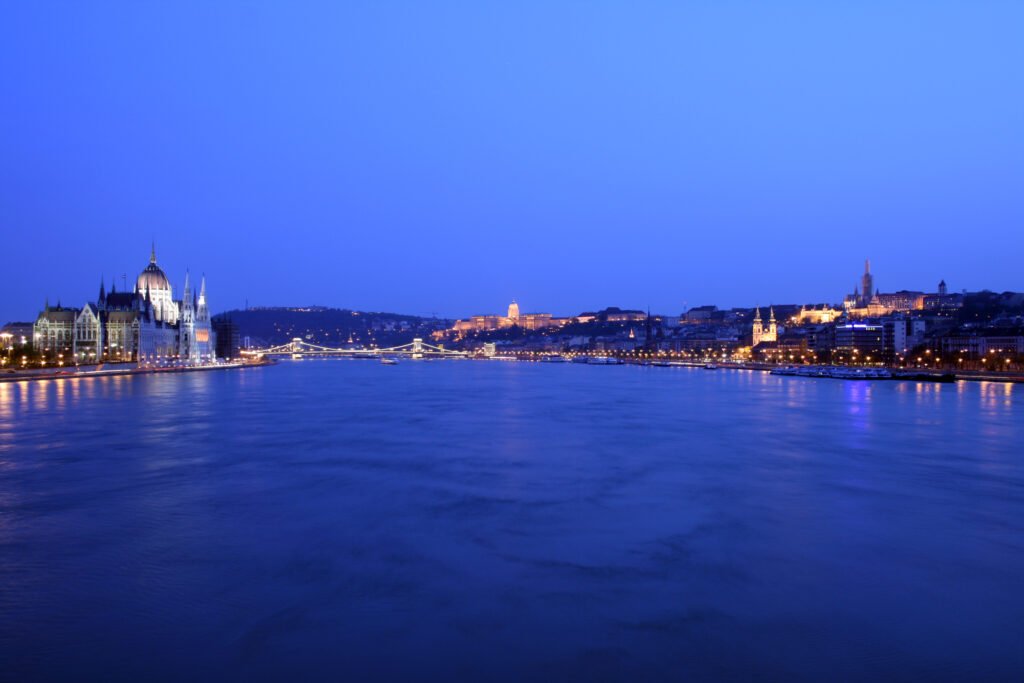

Parliament and the Great Market Hall anchor opposite ends of Budapest’s broad central Pest walking corridor. Between them, riverfront promenades, formal squares, and older commercial streets offer several useful routes rather than one sightseeing street. The Basilica sits just inland from the Danube, while the Jewish Quarter stretches east into a different street grid. Across the Chain Bridge, Buda Castle looks close but stands well above the river. The level surfaces of Pest give way to cobblestones, slopes, and stair access around Castle Hill. Heroes’ Square, City Park, and Margaret Island add further destinations that deserve deliberate side trips.

Why Budapest Works Best in Walking Clusters
The Pest core is the most natural continuous walk. The Parliament, Danube memorials, St. Stephen’s Basilica and the streets around Deák Ferenc tér lie close enough to explore without a vehicle. Farther south, Vörösmarty tér, Váci utca and the Great Market Hall extend the route toward Liberty Bridge. The Jewish Quarter lies east of this line, around Dohány, Kazinczy and adjacent streets. It is a useful walkable branch, not an entirely separate destination.
The Chain Bridge provides a direct pedestrian crossing from central Pest to Clark Ádám tér in Buda. Elisabeth Bridge and Liberty Bridge also connect useful inner-city approaches, while Margaret Bridge leads toward the island. These crossings make the Danube traversable, but do not eliminate distance or climbing. Castle Hill’s attractions sit together above the river; Gellért Hill is another higher, distinct zone. The long approach along Andrássy Avenue to Heroes’ Square and City Park is walkable but much better treated as its own outing.
The Best Areas to Stay Without a Car
District V (Belváros and Lipótváros) is the most versatile base. Staying between the Basilica, Deák Ferenc tér and Vörösmarty tér gives easy access to central sightseeing and the metro. The Parliament end is quieter in some streets but farther from the Great Market Hall. Inner District VI, around the Opera, suits travelers who want Andrássy Avenue and M1 access to City Park without sacrificing an easy walk to the Basilica.
Inner District VII, near Astoria or Deák Ferenc tér, keeps the Jewish Quarter close and makes central Pest manageable; check lodging noise on busy evening streets. Lower Buda around Batthyány tér offers attractive Parliament views and metro access, but most Pest destinations require a crossing or transit. Staying high on Castle Hill can mean picturesque surroundings alongside steeper arrivals with luggage. Avoid assuming a hotel called “central” is equally convenient on both banks.
Realistic Walking Times Between Major Sights
Parliament to the Shoes on the Danube Bank: about 5–8 minutes. Parliament to St. Stephen’s Basilica: roughly 12–15 minutes. The Basilica to the Opera: around 8–12 minutes, while the Basilica to the Pest end of the Chain Bridge: around 8–12 minutes. Allow approximately 18–25 minutes between Vörösmarty tér and the Great Market Hall when following Váci utca.
Across the Chain Bridge, allow about 8–12 minutes between the Pest bridgehead and Clark Ádám tér. From there, climbing on foot to the Buda Castle Royal Palace can take 15–25 minutes, depending on the path and steps. The palace to Matthias Church is roughly 12–18 minutes across the hilltop. Fisherman’s Bastion is only a few minutes from the church. From the Opera, walking along Andrássy Avenue to Heroes’ Square takes roughly 30–40 minutes.
A walk from Parliament to the southern entrance of Margaret Island, via Margaret Bridge, is roughly 25–35 minutes. These are planning ranges for an ordinary pace, not live-navigation guarantees. Add time for crossings, crowds, photography and any interior visits.
A Practical Two-Day Budapest Walking Route
Day 1: Parliament, the Basilica, Jewish Quarter and Market Hall
Start at Kossuth Lajos tér outside the Hungarian Parliament, then follow the Danube south to the Shoes on the Danube Bank. Pause near the Pest side of the Chain Bridge before turning inland to St. Stephen’s Basilica. Continue to the Hungarian State Opera and the nearby Andrássy Avenue streetscape. This brief northern spur is preferable to trying to walk the entire boulevard to City Park in the same sightseeing stretch.
Work southeast into the Jewish Quarter around Kazinczy utca, then visit the exterior of the Dohány Street Synagogue. From there, head southwest through the inner city toward the pedestrian sections of Váci utca. Follow the street south to Fővám tér and the Great Market Hall. The full day is about 6–8 km of walking with chosen local streets and detours; food, museums and interior tours can make it a full day.
Walking route
Day 1: Parliament to the Great Market Hall through central Pest
- Hungarian Parliament Building
- Shoes on the Danube Bank
- Széchenyi Chain Bridge, Pest bridgehead
- St. Stephen’s Basilica
- Hungarian State Opera
- Kazinczy Street, Jewish Quarter
- Dohány Street Synagogue
- Váci Street (southern section)
- Great Market Hall

Day 2: Cross the Chain Bridge and Traverse Castle Hill
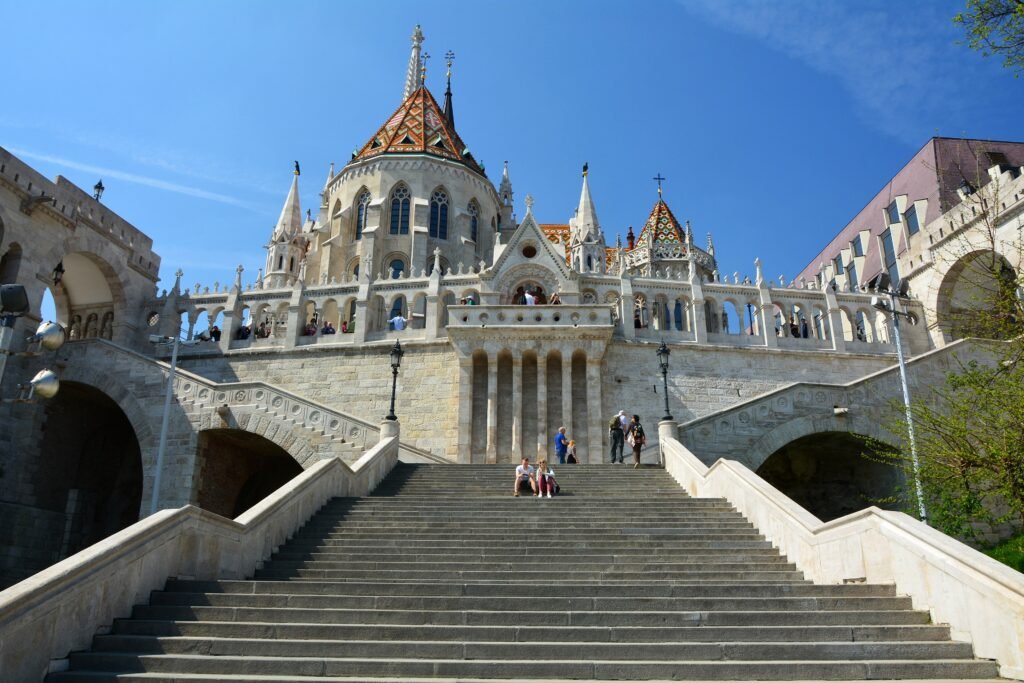
Begin at Széchenyi István tér and walk across the Chain Bridge to Clark Ádám tér. Climb toward Szent György tér and Buda Castle, using the steps or road according to your ability. The Castle Hill Funicular is a separately ticketed alternative that avoids the main ascent. Explore the Royal Palace terraces, then progress north through Dísz tér to Matthias Church and Fisherman’s Bastion. The hilltop is gentler than its approach but has cobbled sections.
Continue toward the Vienna Gate, then descend northwest to Széll Kálmán tér. This one-way progression prevents an unnecessary trip back to the Chain Bridge. Budget roughly 3.5–5 km of walking, plus the hill ascent unless you use transit. Bus 16 is another practical option when stairs or the climb are unsuitable. For an accessible route, inspect exact entrances and stop facilities in BudapestGO before committing.
Walking route
Day 2: Chain Bridge to Castle Hill, finishing at Széll Kálmán tér
- Széchenyi Chain Bridge, Pest bridgehead
- Széchenyi Chain Bridge, Buda bridgehead
- Szent György Square
- Buda Castle Royal Palace
- Dísz Square
- Matthias Church
- Fisherman’s Bastion
- Vienna Gate
- Széll Kálmán Square
Where Transit Saves the Most Walking
Metro M1 runs beneath Andrássy Avenue and is the easiest way to connect the Opera and central Pest with Heroes’ Square and City Park. The M2 crosses between central Pest and Buda, serving Keleti, Deák Ferenc tér, Batthyány tér and Déli. The M3 helps with Nyugati, Deák and Kálvin tér, while M4 links Keleti with Kálvin tér and beyond. Trams and buses fill many gaps the metro leaves.
Tram 2 is particularly useful along the Pest Danube embankment. The 4 and 6 trams cross Margaret Bridge on the Grand Boulevard; tram 6 also provides overnight service. On Castle Hill, bus 16 cuts out an uphill approach. Check live routes using BKK’s visitor guidance and BudapestGO. Regular single tickets generally need validation; the funicular and airport 100E use separate fare rules.
City Park, Margaret Island and Gellért Hill Are Separate Extensions
Heroes’ Square and City Park sit at the far end of Andrássy Avenue. Walking there from the Opera is feasible but adds considerable distance to a day already packed with inner-city sights. The M1 lets you spend that energy on the park’s paths, museums and the Széchenyi Baths area instead. Margaret Island is a relaxing green detour reached from Margaret Bridge, with trams 4/6 stopping at the island entrance and bus 26 serving the island. Its interior paths are practical, but a full island visit adds meaningful walking mileage.
Gellért Hill and the Citadella demand a different calculation from flat Pest. The hill has steep approaches, paths and steps; allow a separate excursion rather than adding its climb casually to Castle Hill day. Tram connections toward Szent Gellért tér or Rudas can shorten the low-value approach, but do not remove the actual ascent. The renovated Citadella reopened on March 28, 2026, and its public park and several viewpoints are open without an exhibition ticket. Check official Citadella opening hours, which vary by season.
Arriving in Budapest Without a Car
From Budapest Ferenc Liszt International Airport, the 100E Airport Express runs directly to Deák Ferenc tér via Kálvin tér in approximately 40 minutes. The service runs 24 hours; its special one-way fare was 2,500 HUF at the time of this update. It is not covered by an ordinary single ticket. Bus 200E is the standard-fare alternative, connecting with M3 at Kőbánya-Kispest during metro operating hours and with night buses via Határ út overnight. The airport’s Ferihegy railway stop is not at Terminal 2; it requires a 200E transfer.
Rail arrivals are also straightforward once you identify your station. Keleti pályaudvar connects with metros M2 and M4. Nyugati pályaudvar has M3 and trams 4/6, while Déli pályaudvar connects to M2 on the Buda side. None of those three terminals places every visitor sight within a short walk, but onward public transport is generally simple. Check your actual station and current train service before selecting accommodation.
Walking Limitations and Accessibility
Budapest’s main Pest corridors offer generous stretches of sidewalk and pedestrianized shopping streets, but crossings still matter. Wide boulevards, embankment traffic and bridgeheads can interrupt an otherwise easy route. Crowding around Parliament, the Basilica, the Chain Bridge and the Castle District may slow walking. On Buda, consider cobblestones, grades and stairs before assuming that a nearby landmark is easy to reach. A route that is flat on Pest can become significantly more demanding immediately beyond the bridge.
Wheelchair users, visitors with strollers and travelers avoiding stairs should choose specific approaches rather than generic shortest paths. BKK publishes accessible vehicle and journey-planning information, and bus 16 may be preferable to a steep pedestrian approach. Individual Castle District streets, elevators, viewpoints and Citadella paths have differing accessibility. Confirm route and lift conditions before setting out; an accessible bridge crossing does not guarantee the entire hill itinerary is step-free.
When a Car Helps — and When It Does Not
A private car brings little benefit for this two-day city visit. Central sightseeing involves pedestrian zones, traffic controls, busy approaches and scarce convenient stopping places. Transit already covers the main jumps between clusters. A car becomes more relevant for independently arranged rural excursions or multiple dispersed destinations outside Budapest, although rail and buses also serve many regional trips. For a first weekend concentrated on the capital, travel without one.
Seasonal Walking Conditions
In summer, exposed Danube promenades and uphill routes can become hot, so plan shade and water breaks. Winter brings wind along the river and shorter daylight for viewpoints. Rain, snow or ice make stone paving and hillside steps less comfortable than the flat Pest grid. Central parks remain useful for walking in appropriate conditions, but a seasonal forecast should guide the order of activities rather than the city’s underlying suitability for walking.
Bottom Line
Budapest suits a two- or three-day car-free visit when walks are grouped logically. Central Pest supplies the most continuous pedestrian sightseeing, and the Chain Bridge makes Castle Hill accessible within a second, more strenuous cluster. Reserve the M1, trams and buses for City Park, Margaret Island, Gellért Hill and other longer links. This preserves the enjoyable walks without mistaking the city’s excellent transport for uniformly easy terrain.