
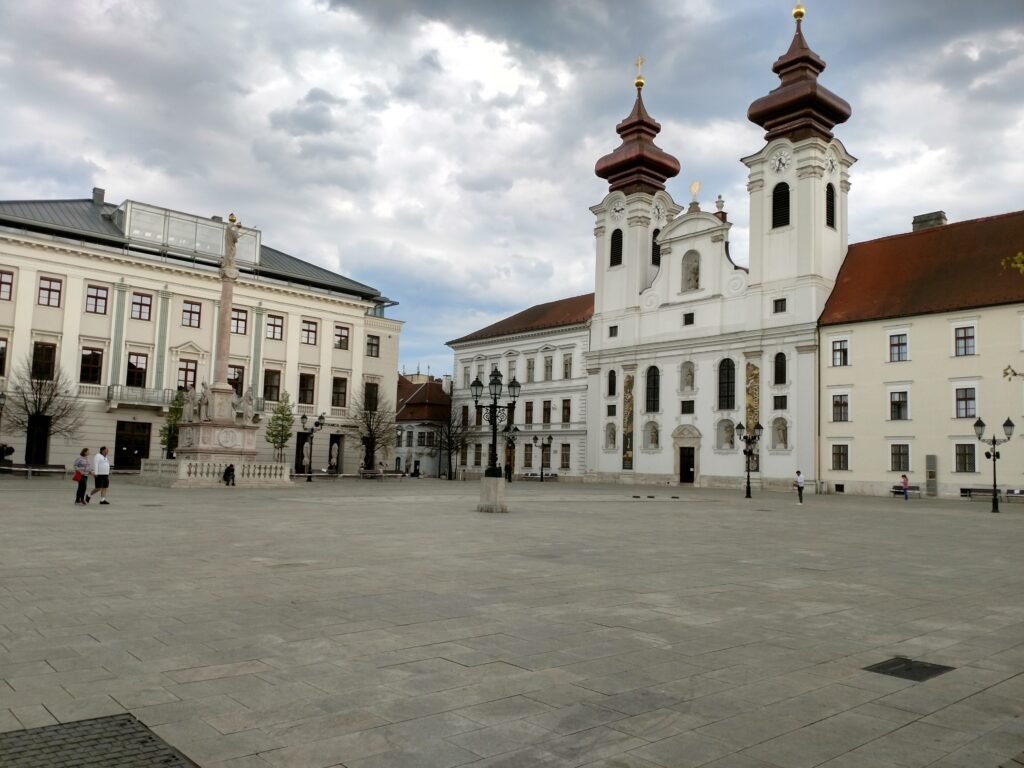

Two rivers, three historic squares, and a short climb to Chapter Hill shape a Győr weekend. The pedestrian stretch of Baross Gábor Street leads toward Széchenyi Square, where the Benedictine church anchors the Baroque core. Another compact chain reaches Dunakapu Square, the cathedral, and Bécsi kapu Square without needing a neighborhood transfer. Near the Rába, Radó Island turns a bridge crossing into a worthwhile green detour. The wider visitor map is less concentrated, with the zoo east of downtown and Mobilis north of the Mosoni-Danube. Flat ground eases most routes, although older paving, river crossings, and busy approaches interrupt the smoothest lines.
Why Győr’s Baroque Core Works on Foot
The first-time sightseeing core is unusually coherent. Széchenyi Square joins the Benedictine Church of St. Ignatius, historic houses, and the nearby Esterházy Palace. Baross Gábor Street provides a straightforward pedestrian approach from City Hall and the railway station. Short lanes lead north to the Mosoni-Danube at Dunakapu Square, while a small westward rise reaches Győr Cathedral and the Bishop’s Castle at Káptalandomb. This is a practical group of neighboring sights, not a set of distant attractions connected only by transit.
The large historic squares are generally comfortable to cross and easy to orient around. Some church entrances, historic courtyards, stone surfaces, and curb transitions are less straightforward for travelers with limited mobility. The strongest pedestrian conditions are concentrated within the core; do not assume equivalent conditions across major roads and the eastern residential approaches.
Rivers and Bridges: Scenic Connections, Not Shortcuts Everywhere
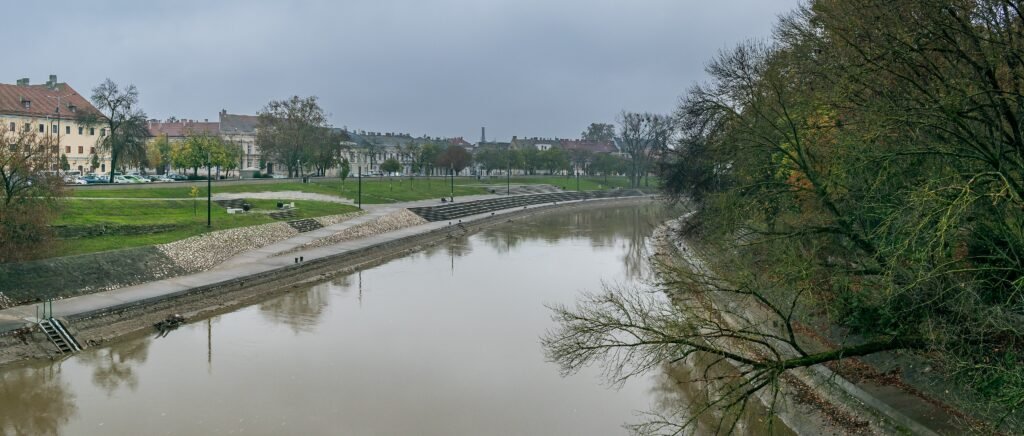
The Mosoni-Danube runs along the northern edge of the old town, with Dunakapu Square opening onto the water. The Rába bends around the western side, separating parts of Újváros from the historic center. The Rába double bridge makes Radó Island a natural short detour from Bécsi kapu Square. The smaller Ifjúság footbridge leads onto the Sziget side near the confluence. To reach Kossuth Bridge by continuing around the river, cross Jedlik Ányos Bridge into Révfalu first.
These crossings make several riverside sights accessible and rewarding. They also determine the route: a point may look close across the water but require a particular bridge. Stay on one bank until the next useful crossing rather than repeatedly returning through the old town. Riverside promenades are worth walking for the views, but they are not an uninterrupted shortcut to every outer attraction.
Best Areas to Stay Without a Car
Around Széchenyi Square: the easiest base for historic architecture, cafés, museums, and relaxed evening walks. Baross Gábor Street and City Hall: particularly convenient for railway arrivals and access to buses, while still close to the pedestrian core. Bécsi kapu Square or the Chapter Hill edge: a quieter option near the Cathedral, Carmelite Church, and Rába riverbank; check steps in historic properties. West-bank Újváros has character, but its bridge approaches make station access less direct.
Walking Times Between Major Győr Sights
From Győr railway station to City Hall allow roughly 3–6 minutes; continue to Széchenyi Square in about 10–15 minutes total. Széchenyi Square to Dunakapu Square is approximately 4–7 minutes. Allow 6–9 minutes from Széchenyi Square to the Cathedral on Chapter Hill, and another 4–7 minutes to Bécsi kapu Square. The Rába double bridge puts Radó Island about 2–5 minutes beyond that square.
These are ordinary route-planning estimates, not live navigation results. Stops, crossings, stair-free access, and crowding can add time. Mobilis is a longer 25–35 minute walk from Dunakapu Square across Kossuth Bridge; the zoo is a substantially longer urban walk. Use a local bus for the zoo unless the transfer itself is part of your day.
A Two-Day Walking Route Through Győr
Day 1: Baroque Streets, Cathedral, and Riverfront
Begin at Győr railway station and take in the grand City Hall. Follow Baross Gábor Street north to Széchenyi Square, then visit the Benedictine church and nearby Esterházy Palace if open. Continue through the historic lanes to Dunakapu Square and the Mosoni-Danube. From there, rise to Káptalandomb for the Cathedral and Bishop’s Castle. Follow the west-side historic paths down to Bécsi kapu Square and the Carmelite Church. This sequence keeps the day moving across the compact old town.
Walking route
Baroque center, Chapter Hill, and western squares
- Győr railway station
- Győr City Hall
- Baross Gábor pedestrian street
- Széchenyi Square
- Benedictine Church of St. Ignatius
- Esterházy Palace
- Dunakapu Square
- Győr Cathedral
- Bishop’s Castle and lookout tower
- Bécsi kapu Square and Carmelite Church
Plan roughly 2–3 kilometers of walking before optional museum circuits and riverside detours. Entry arrangements for church and lookout spaces may vary; the public streets and squares remain the core of the walk. A café stop near Széchenyi Square can be fitted into the first half of the route without a long return journey.
Day 2: Újváros, Radó Island, and the River Crossings
Start in Újváros at the Győr Synagogue on Kossuth Lajos Street. Visit nearby west-bank streets, then cross the western Rába double-bridge span near Rát Mátyás Square. Explore Radó Island and follow its paths north to the Ifjúság footbridge. This lands in Sziget. Continue northwest to Jedlik Ányos Bridge, cross the Mosoni-Danube into Révfalu, and follow the northern waterfront east. Finish via Kossuth Bridge at Dunakapu Square. The extra bridge is essential; there is no direct riverside shortcut from the footbridge to Kossuth Bridge.
Walking route
Újváros, Radó Island and the three river channels
- Győr Synagogue
- Újváros historic streets
- Rát Mátyás Square
- Rába double bridge
- Radó Island
- Ifjúság pedestrian bridge
- Jedlik Ányos Bridge
- Kálóczy Square
- Kossuth Bridge
- Mosoni-Danube riverfront at Dunakapu

Allow around 4–5.5 kilometers, depending on how far you follow the riverside paths. This is deliberately a longer but scenic river-and-bridge walk with places to stop, not a forced march to outlying attractions. The synagogue’s interior access is separate from the public street route. If a science-center visit matters more, plan Mobilis as a distinct extension and check its opening day first.
When Győr’s Local Buses Become Useful
The Xantus János Zoo is in Kiskút liget, east of the historic center. Bus 8 or 8Y serves the zoo entrance, making it a better option than walking the entire distance through ordinary urban streets. The Mobilis Interactive Experience Center is north of the Mosoni-Danube at Vásárhelyi Pál Street 66. The center recommends bus 19 and publishes a pedestrian route via Kossuth Bridge. It is reachable on foot, but not part of the compact Baroque sightseeing loop.
Mobilis currently lists weekday opening and says Saturdays and Sundays are closed except for special themed days. That makes it an unreliable default weekend stop. Local buses have published line timetables, but frequency and service patterns differ by route and day. Check the official Győr bus timetable for the relevant outbound and return services.
Arriving in Győr Without a Car
Győr’s main railway station sits just south of the old town, close to City Hall and the start of Baross Gábor Street. The station is on the Budapest–Győr–Vienna corridor, and travelers can reach the city using intercity or international trains that call here. Services are frequent compared with many smaller historic cities, although exact patterns and stations vary. From Vienna, the rail journey also makes Győr a practical stop on a larger Austrian-Hungarian itinerary; see our Vienna walking guide for the other end of that journey.
Neither Vienna Airport nor Budapest Airport sits beside Győr. Flying visitors normally need an airport rail or urban transfer before their intercity leg. Current advisory, checked November 7, 2026: engineering works on the Budapest–Győr–Hegyeshalom line affect selected trains through December 12, 2026. Some Budapest intercity services are scheduled from Kelenföld rather than Keleti. Confirm your exact train and Budapest departure station with MÁV or ÖBB before traveling.
Walking Conditions and Accessibility
The historic center favors pedestrians, especially around the large squares and the Baross Gábor shopping spine. Street surfaces are not uniformly smooth: stone paving, older thresholds, narrow side streets, and church entrances can present difficulties for wheelchairs or rolling luggage. Káptalandomb adds a modest incline, not a sustained hill climb. Main-road crossings south of the old town and vehicle access near bridge approaches demand more attention than the pedestrian plazas.
Use marked crossings and check step-free entrances individually where accessibility is essential. The public riverbank paths are pleasant, but a bridge or waterside ramp may be the limiting part of a particular route. An accessible itinerary should prioritize the broad central squares and independently verify each historic building, rather than treating the entire old town as barrier-free.
When a Car Might Help
A car is unnecessary for the core sightseeing weekend. It becomes more useful for multi-stop countryside travel, remote places beyond dependable public transport, or a tightly scheduled collection of outlying attractions. The zoo is reachable by bus, and Mobilis is reachable by bus or a longer walk, so neither requires a car on its own. For nearby day trips, check rail and regional buses before deciding to rent one.
Seasonal Notes for the Riverfront
Spring and early fall usually make longer walks along the rivers especially inviting. Summer afternoons can feel exposed on open squares, while the tree cover on Radó Island offers relief. Winter winds and shorter daylight can make riverside detours less appealing. High water or maintenance may occasionally affect individual paths; treat these as temporary access issues and check local notices when planning a long waterfront walk.
The Bottom Line
Győr works best when the Baroque streets, Chapter Hill, and the rivers are treated as one walkable central experience. Stay close to Széchenyi Square or Baross Gábor Street, then explore the bridge-linked riverside areas on a separate day. For the zoo or Mobilis, use a targeted bus journey rather than assuming every highlight sits inside the old town.