
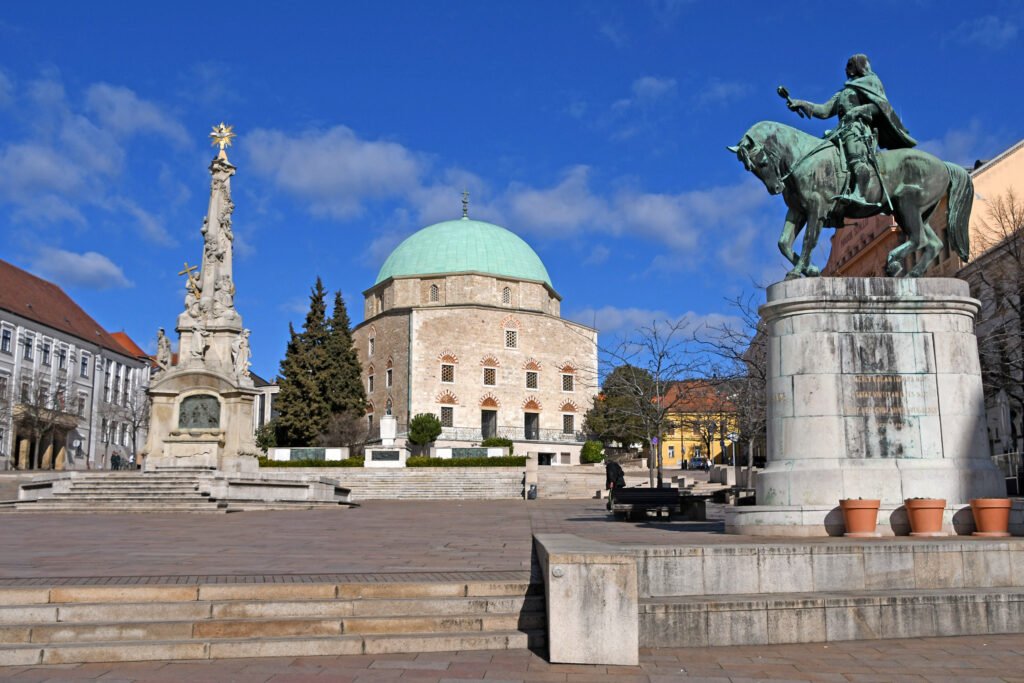

The main square of Pécs opens directly into a chain of Ottoman, medieval and Roman-era landmarks. Széchenyi tér holds the Mosque of Pasha Qasim, while Király Street forms an eastbound pedestrian spine. Westward, short lanes reach the cathedral, Cella Septichora and nearby museums without a vehicle transfer. This close-knit core is only one part of the visitor map. The Zsolnay Cultural Quarter extends farther east, past less sheltered crossings and ordinary streets. North of the old town, Tettye climbs into the Mecsek foothills, making nearby attractions more strenuous to reach. These contrasts shape a practical two-day visit.

Why Pécs Works on Foot
Széchenyi Square is a reliable starting point. The Mosque of Pasha Qasim, now used as a church, stands within the broad pedestrian space. From the square, Király Street leads toward the National Theatre and a continuous run of cafés and historic façades. The center is genuinely compact, rather than simply convenient because the city has buses. Most headline sites around Belváros require only a few minutes between stops.
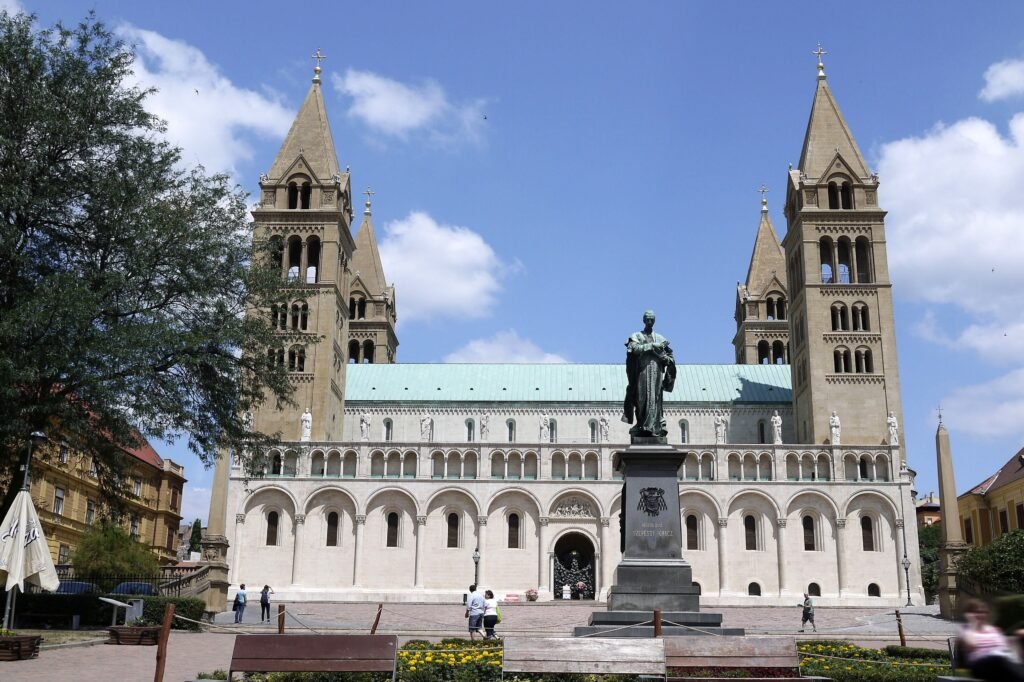
The cathedral and UNESCO-listed Early Christian Necropolis sit west of the square. Follow Janus Pannonius Street toward the Cella Septichora Visitor Center and Dóm tér. Underground Roman burial chambers lie within the World Heritage property, close to the cathedral and the Csontváry and Vasarely museum area. A traveler can spend a full central day walking these streets without relying on local transport.
Where the Compact Center Ends
The Zsolnay Cultural Quarter is not on Széchenyi Square. It occupies a restored former ceramics-factory campus east of the old center, reached by the Király Street and Felsővámház Street approach. From the square, allow roughly 20–25 minutes, depending on the entrance and your pace. The walk is practical but includes conventional sidewalks and crossings instead of continuous pedestrian-zone conditions. Once there, the Quarter has its own grounds, exhibitions and courtyards.
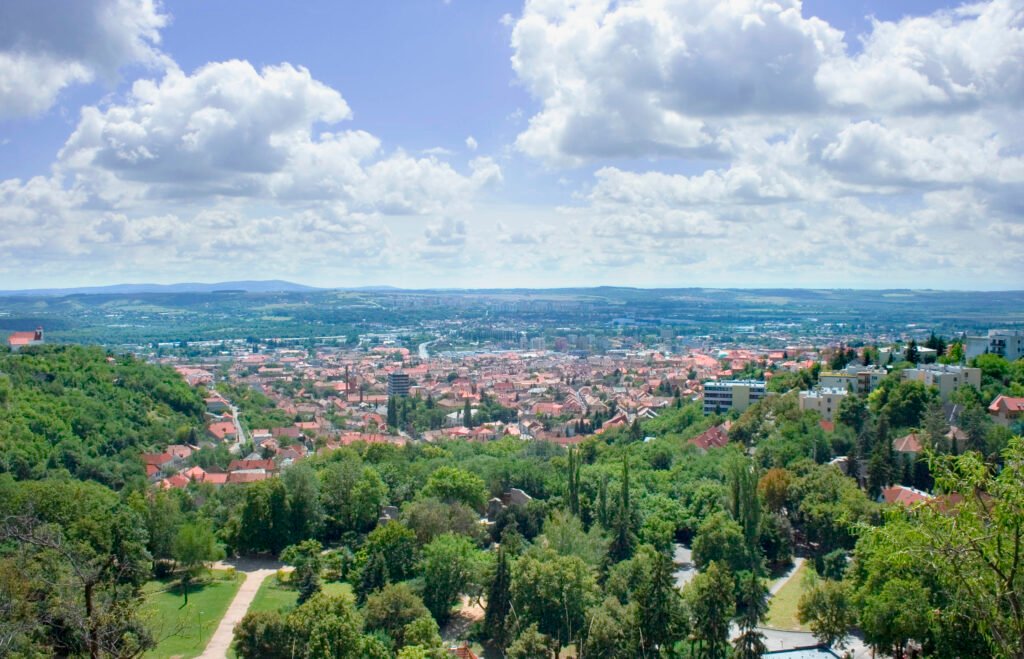
Tettye is a different kind of extension. Its park and ruins lie on the rising northern side of Pécs, beneath the Mecsek hills. Although a map may make Tettye look adjacent to Belváros, the climb changes the effort considerably. Paths toward Havihegy can add stairs and steeper sections. It is reasonable to walk up and take a bus or taxi downhill, especially after a full day of museums.
Best Areas to Stay Without a Car
Széchenyi Square and central Király Street: the simplest base for sightseeing, dining and evening walks. The main heritage cluster is immediately accessible. Cathedral and Sétatér: especially convenient for Cella Septichora and the museums, with a slightly quieter setting. Eastern Király Street and Ágoston Square: a sensible compromise for a visitor prioritizing the Zsolnay Cultural Quarter. Railway-station side: convenient for an early train but noticeably farther from the old-town landmarks. Prioritize a central address over a hillside property if you want to minimize climbing.
Realistic Walking Times in Pécs
These are approximate visitor estimates, not live route guarantees. Crossing delays, museum entrances, footwear and uphill gradients can change the time.
Near the main square: the Mosque of Pasha Qasim stands on Széchenyi Square itself (0–2 minutes), while the National Theatre is a 4–6-minute walk along Király Street.
Western heritage precinct: allow 6–9 minutes from Széchenyi Square to Cella Septichora, or 8–11 minutes to Pécs Cathedral. Cella Septichora and the cathedral are about 2–4 minutes apart.
Eastern and northern extensions: from the square, Zsolnay Cultural Quarter takes roughly 20–25 minutes. Tettye Park takes 25–35 minutes uphill, depending on the approach and fitness.
Railway station: the walk from Pécs station to Széchenyi Square usually takes 15–20 minutes; a bus is useful with heavy luggage.
A Two-Day Walking Route
Day 1: Király Street, the Cathedral and Roman Pécs
Walking route
Day 1 — Király Street to the cathedral and World Heritage precinct
- Ágoston Square (Ágoston tér)
- Király Street (Király utca)
- Pécs National Theatre
- Mosque of Pasha Qasim
- Zsolnay Fountain
- Csontváry Museum
- Cella Septichora Visitor Center
- Pécs Cathedral
- Barbican (Barbakán)
Begin at Ágoston Square and follow Király Street west through the pedestrian center. Pause at the National Theatre, then reach Széchenyi Square and the mosque-church. Continue toward the Zsolnay Fountain before walking west along the streets around the Csontváry Museum. Visit Cella Septichora and the cathedral precinct, then finish at the Barbican. This east-to-west line avoids walking the same central blocks twice. Leave extra time for the UNESCO underground exhibits and check museum opening days.
Day 2: Zsolnay Cultural Quarter and Tettye
Walking route
Day 2 — Zsolnay Quarter and the Tettye hillside
- Zsolnay Cultural Quarter
- Felsővámház Street
- Ágoston Square (Ágoston tér)
- All Saints Church (Mindenszentek temploma)
- Tettye Park and Ruins
- Church of Our Lady of the Snows (Havihegy)
Start at the Zsolnay Cultural Quarter, giving its restored factory buildings and exhibitions time rather than treating them as a quick photograph. Continue west along Felsővámház Street toward Ágoston Square, then turn uphill past the All Saints Church area toward Tettye Park and its ruins. The final approach requires more effort than Day 1. Havihegy is an optional continuation for confident walkers, not an essential stop. Finish in the hillside neighborhood and use a return bus or taxi if another descent would be uncomfortable.

Do You Need Local Buses?
Not for the central visitor sights. Király Street, Széchenyi Square, the UNESCO necropolis and cathedral are all better explored on foot. Tüke Busz becomes useful for the railway station with luggage, a return from the Tettye hillside or trips beyond the central area. Its bus network also reaches the zoo and, on selected routes, the TV tower. Those hillside destinations should not be confused with the easy downtown walking circuit.
The operator provides an official trip-planning app and mobile tickets. Its English ticket page lists single fares and 24-hour options, while Saturday, Sunday and nighttime services run on their own timetables. Check the exact stop, direction and last return before leaving the center; a citywide network does not mean every hillside bus is frequent.
Arriving in Pécs Without a Car
MÁV operates Mecsek InterCity services between Budapest and Pécs, broadly every two hours under the published pattern. Journey times are commonly around two and a half to three hours, depending on the service and any timetable changes. The main Pécs railway station is at Indóház tér, around a 15–20-minute walk south of Széchenyi Square. Local buses or a taxi make the last portion easier with luggage.
Budapest Ferenc Liszt International Airport is the main practical gateway for most international visitors. Use Budapest public transport to reach the correct departing InterCity station, then continue by train to Pécs. Allow several hours for the full airport-to-city transfer and verify the actual Budapest departure station. Engineering works can affect train routing and connections. The local Pécs-Pogány airport is not a dependable scheduled arrival gateway: the Munich service launched in March 2026 but stopped in June.
When a Car Helps
A car adds little to two days focused on Belváros, Zsolnay and Tettye. Most of the city’s cultural highlights remain accessible on foot, with buses as an energy-saving option. Driving becomes more useful for countryside stops, scattered Mecsek trailheads or a flexible multi-stop regional itinerary. It should not be the default way to move between the central square and the cathedral.
Walking Limitations and Accessibility
The old-town pedestrian streets are comfortable relative to the surrounding roads, but stone paving, occasional uneven surfaces and road crossings still matter. The climb toward Tettye or Havihegy is more demanding than any flat-map distance suggests. Cella Septichora also has significant changes in level. Its operator lists accessible areas, lifts and a stair lift, while recommending advance coordination and an accompanying person for some wheelchair visitors. Confirm individual entrances and routes rather than assuming every UNESCO chamber is equally accessible.
Seasonal Walking Conditions
Pécs typically has warm summers and cool winters. Hungarian meteorological normals put average July daytime highs close to 28°C, so an afternoon Tettye climb can feel more tiring than a morning walk. Rain, frost, snow or ice can make hillside stairs and stone surfaces less secure. Spring and early fall generally give the most forgiving walking conditions. Opening hours for the World Heritage sites and Zsolnay exhibitions can also differ by season or weekday.
Bottom Line
Pécs is a strong choice for a mostly pedestrian city break, provided the compact core and hillside extensions are treated differently. Spend one day among the square, cathedral and UNESCO sites, then give Zsolnay and Tettye their own day. A central hotel minimizes backtracking. Use the bus when steep walking stops adding enjoyment, and arrive by rail rather than depending on the local airport.