
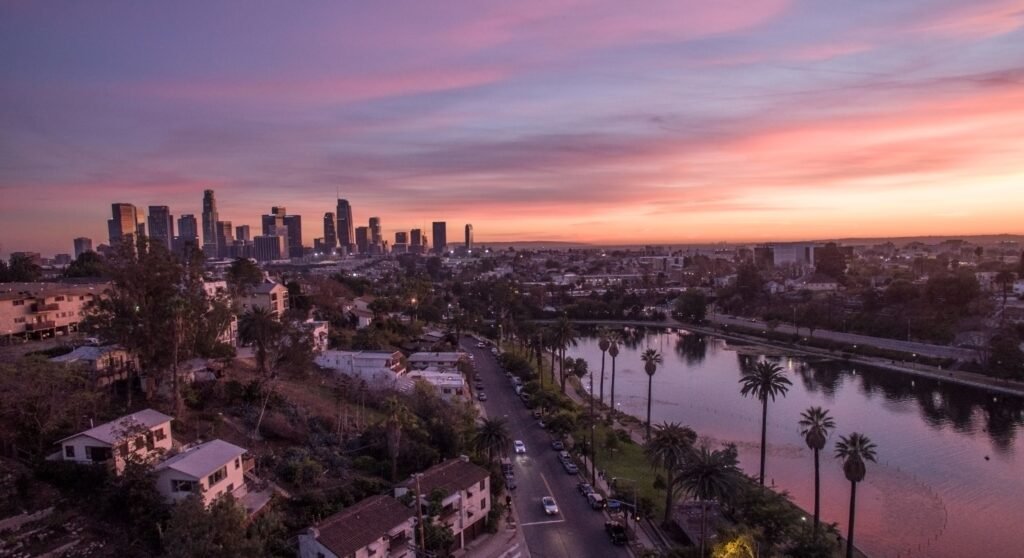
The distances between Los Angeles’s signature visitor areas shape the walking experience more than sidewalk availability alone. Downtown, Hollywood, Mid-Wilshire, and the Santa Monica-Venice coast function as separate pedestrian zones. Several miles, wide arterials, freeways, and hills can separate those zones, making continuous sightseeing walks inefficient. The 2026 D Line extension strengthens the middle of this map by bringing Museum Row and western Wilshire onto rail. Metro now reaches the LAX/Metro Transit Center, adding another useful link for visitors avoiding a private car. That network turns neighborhood choice into the defining decision for a Los Angeles walking weekend.
Where Los Angeles Works Best on Foot
Downtown Los Angeles: Best for Transit and a Full Walking Day
Downtown LA is the most useful all-around car-free base. Union Station, Olvera Street, Grand Park, Bunker Hill, Historic Broadway and Little Tokyo form a string of compact visitor areas, and the Regional Connector has made the rail network through Downtown much more useful. Discover Los Angeles describes Downtown as the hub of the city’s urban rail system and specifically notes that much of the district can be explored without renting a car.
Downtown is not perfectly flat or uniformly pleasant. The climb toward Bunker Hill is noticeable, and some large intersections slow a walking day. But distances between major stops are short enough that museums, architecture, food halls and historic sites can fill a day without constantly calling a ride.
Hollywood Boulevard: Best for Classic First-Time Sights
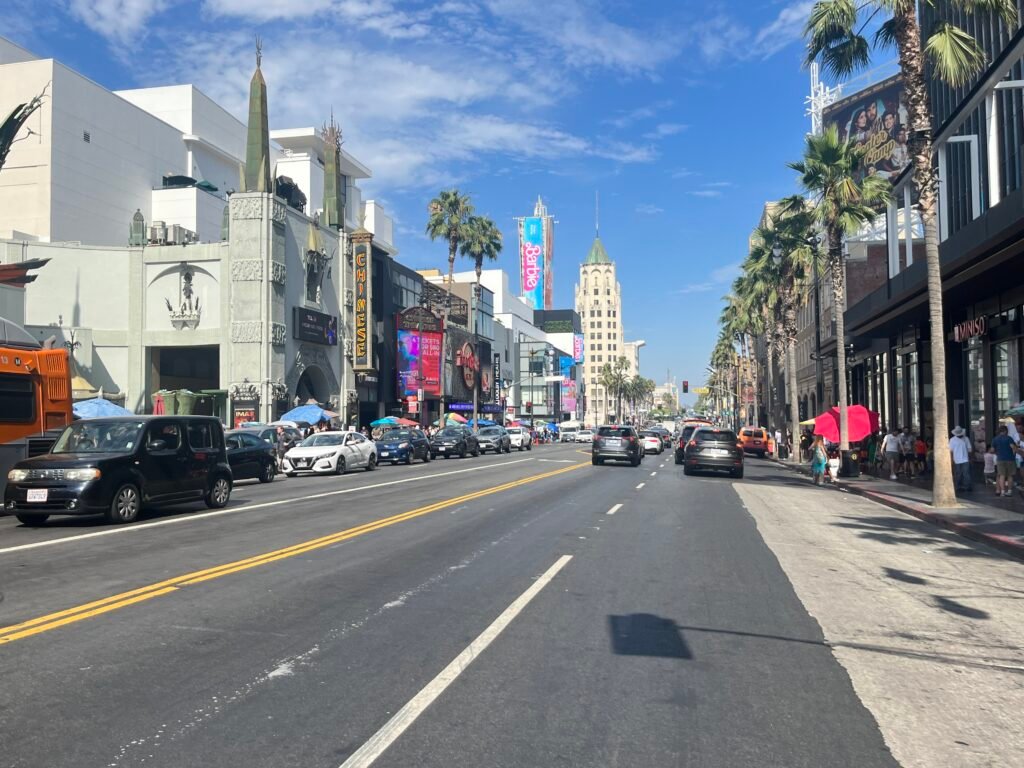
Hollywood’s reputation for sprawl is misleading if your plan is limited to the Boulevard. Around Hollywood/Highland, TCL Chinese Theatre, the Walk of Fame, Dolby Theatre, El Capitan and several museums cluster within a few blocks. The Walk of Fame continues for many blocks east, and the B Line gives the area a direct subway link to Downtown.
The key is to stop treating Hollywood as the whole of Los Angeles. It is a walkable visitor strip connected to other districts by transit. Griffith Observatory, for example, is not a sensible extension of the Hollywood Boulevard walk; use the B Line to Vermont/Sunset and the DASH Observatory connection instead of climbing the hill from Hollywood.
Koreatown and Mid-Wilshire: Much Better After the 2026 D Line Opening
The biggest structural improvement for a 2026 visitor is the D Line extension. Since May 8, trains continue west from Wilshire/Western to Wilshire/La Brea, Wilshire/Fairfax and Wilshire/La Cienega. Metro says the one-seat trip from Union Station to La Cienega is around 20 minutes. For travelers, Wilshire/Fairfax is especially important because it places Museum Row—including LACMA, the Academy Museum, Petersen Automotive Museum and La Brea Tar Pits—on the rail network.
This does not make the Westside compact overnight, but it changes the practical no-car map. A museum day that once required a long bus transfer can now begin on rail, and Koreatown becomes a stronger midpoint base for travelers splitting time among Downtown, Hollywood and Mid-Wilshire.
Santa Monica and Venice: Excellent Walking, but a Separate Coastal Zone
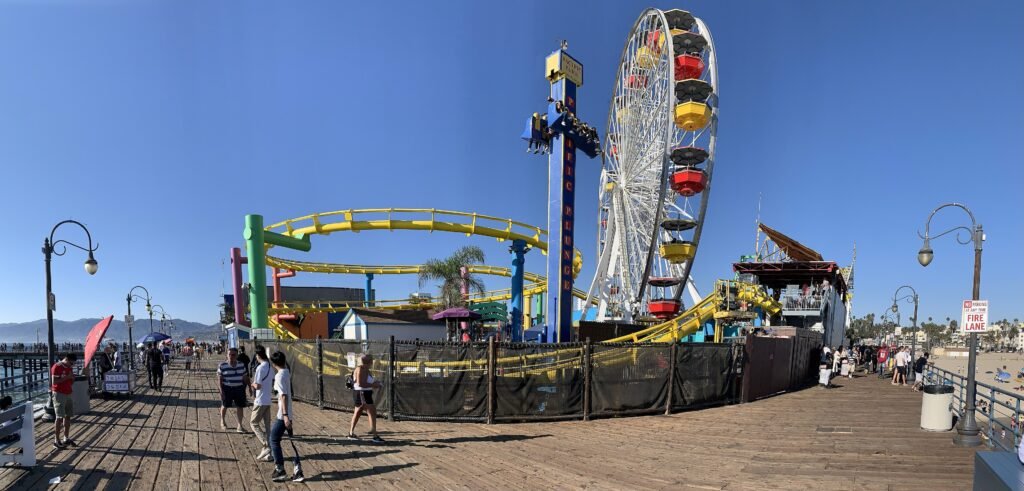
For many visitors, the coast provides the most effortless walking day in the wider Los Angeles trip. Downtown Santa Monica, Third Street, the pier and the beach sit close together, while Venice adds the boardwalk, canals and Abbot Kinney farther south. The E Line connects Downtown Los Angeles with Santa Monica, so this can still be a car-free day.
There is an important geographic distinction: Santa Monica is a separate city, not a Los Angeles neighborhood. It belongs in this guide because it is part of the normal visitor map, but its walkability should not be used to pretend that central Los Angeles is more compact than it is. If the coast is your main priority, staying in Santa Monica is sensible; if you want a balanced first visit, it is a long way from Downtown and Hollywood.
Where to Stay Without a Car
There is no single perfect Los Angeles base. Choose the hotel around the half of the city you expect to use most. Downtown works best for rail connectivity and the Day 1 route. Hollywood/Highland is strongest for classic Hollywood, Universal City and the Griffith connection. Koreatown/Wilshire is a useful compromise now that the D Line reaches Museum Row. Santa Monica is the obvious choice for a coast-first weekend, but it sacrifices convenience for eastern attractions.
For a first trip trying to cover multiple zones without a car, Downtown or Koreatown usually creates the cleanest transit geometry. If you pick a hotel far from a rail station because the nightly rate looks attractive, the saved money can quickly turn into repeated long bus trips or rideshares. In Los Angeles, distance to useful transit matters almost as much as the neighborhood name.
Representative Walking Times
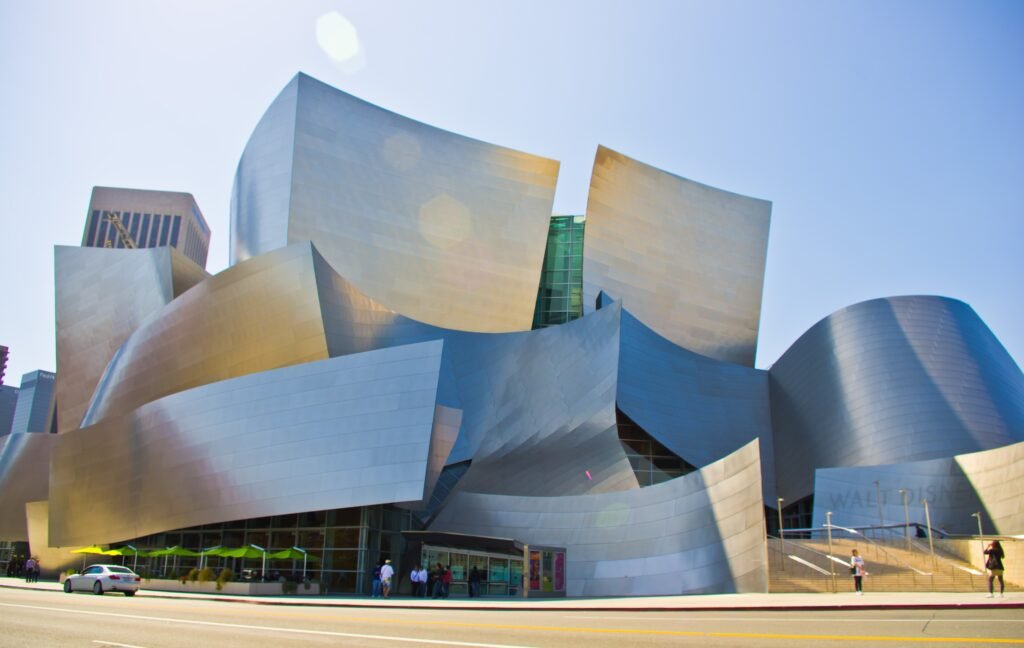
Within Downtown, allow roughly 3–5 minutes from Union Station to Olvera Street, 10–15 minutes from Olvera Street to Grand Park, and another 10 minutes from Grand Park toward Walt Disney Concert Hall and The Broad. The Broad to Grand Central Market is roughly 8–12 minutes, and the market to Little Tokyo is about 15–20 minutes depending on crossings and your exact route.
In Hollywood, TCL Chinese Theatre to Hollywood/Vine is roughly 20–25 minutes of pure walking before attraction stops. Along the coast, Downtown Santa Monica to the pier is usually only about 5–10 minutes. The important counterexample is Downtown LA to Santa Monica Pier: Discover Los Angeles puts that gap at about 15 miles. These are practical planning estimates rather than guaranteed walking times, but they show where walking stops being the efficient choice.
A 2-Day Los Angeles Route Without a Car
This itinerary does not waste time proving that Los Angeles is large. Day 1 stays inside Downtown, where attractions genuinely connect on foot. On the second day, take the B Line directly to Hollywood, then walk toward Hollywood/Vine before continuing to Griffith Observatory by transit.
Day 1: Union Station to Little Tokyo via Bunker Hill
Walking route
Day 1: Union Station, Historic Downtown, Bunker Hill and Little Tokyo
- Los Angeles Union Station
- Olvera Street / El Pueblo de Los Angeles Historical Monument
- Gloria Molina Grand Park
- Walt Disney Concert Hall
- The Broad
- Angels Flight Railway
- Grand Central Market
- Bradbury Building
- Japanese Village Plaza
Start at Los Angeles Union Station and cross into El Pueblo de Los Angeles Historical Monument and Olvera Street. From there, walk south toward Gloria Molina Grand Park and climb toward Bunker Hill for Walt Disney Concert Hall and The Broad. These stops are close enough that the day feels like a continuous city walk rather than a chain of transfers.
Descend toward Angels Flight and Grand Central Market, then cross Broadway for the Bradbury Building. Finish by walking east into Little Tokyo at Japanese Village Plaza. If your feet are done, Little Tokyo/Arts District Station gives you an easy rail exit instead of forcing a return walk to Union Station.
Day 2: Hollywood Boulevard, Then Griffith Observatory
Walking route
Day 2: Hollywood Boulevard on Foot, Then Transit to Griffith Observatory
- Hollywood/Highland Metro Station
- TCL Chinese Theatre
- El Capitan Theatre
- Egyptian Theatre
- Hollywood Walk of Fame at Vine Street
- Capitol Records Building
- Pantages Theatre
- Amoeba Music Hollywood
- Hollywood/Vine Metro Station
Take the B Line to Hollywood/Highland. Begin with TCL Chinese Theatre and El Capitan, then continue east along Hollywood Boulevard through the Walk of Fame corridor. The mapped route includes the Egyptian Theatre, Hollywood/Vine, a short Capitol Records detour, the Pantages Theatre and Amoeba Music before returning to the Hollywood/Vine transit node.
Do not finish the day by trying to walk from Hollywood Boulevard to Griffith Observatory. Instead, take the B Line to Vermont/Sunset and transfer to the DASH Observatory service. The Observatory itself says public transportation is the easiest way to visit. This is a good example of how Los Angeles works without a car: walk where the urban fabric supports it, then use a short transit link when terrain and distance stop making sense.
Getting Around Los Angeles Without a Car
Metro is now useful enough that visitors should stop treating it as an afterthought. The rail system has six lines and 115 stations. For a short trip, the B Line handles Downtown–Hollywood, the D Line serves Downtown–Koreatown–Mid-Wilshire, the E Line reaches Exposition Park and Santa Monica, while the C and K Lines are central to the LAX connection.
The standard fare is $1.75, transfers are free within two hours when you tap, and fare capping limits eligible tapped travel to $5 per day and $18 per seven days. Metro also accepts contactless credit/debit cards as well as TAP. That makes the network easier for a weekend visitor than older LA transit advice may suggest.
Frequency is usable rather than turn-up-and-go perfect. Metro’s current Central LA/Westside map lists the A, B, C, D, E and K lines at roughly 10–20 minute weekend daytime intervals and generally 15–20 minutes in the evening. Missing one train can therefore matter more than in New York or central London. Check live service before leaving an attraction, especially during maintenance windows.
Buses and DASH fill important gaps, but traffic can still make surface transit slow. Use them for destinations that rail does not reach well rather than trying to stitch every neighborhood together by bus. For awkward late-evening cross-town trips, a rideshare can be a sensible supplement without turning the entire weekend into a car trip.
Arrival Without a Car: LAX to the City
LAX is easier without a car than it used to be, but the airport transfer still requires some planning. The LAX/Metro Transit Center connects with the C and K Lines. Until direct terminal access through the People Mover is operating, passengers use the airport’s shuttle connection between the terminals and transit center. Check current LAX and Metro guidance before travel because this access pattern is changing.
Metro says a trip from Downtown Los Angeles to LAX generally takes about 45–60 minutes, depending on origin and connections. If you are staying Downtown, the alternative is the FlyAway bus to Union Station. Its current one-way fare is $12.75, and it reaches the terminals directly, although Los Angeles road traffic can make the travel time less predictable.
For a Union Station or Downtown hotel, FlyAway is often the simplest arrival because it removes rail transfers and the terminal shuttle. For a hotel better aligned with the C/K Line corridor, Metro can be cheaper and more predictable. Re-check the airport People Mover status immediately before travel: once it opens, the balance between those two options will change.
When a Car or Rideshare Becomes Useful
You do not need a rental car for the two-day Downtown and Hollywood itinerary above. A car becomes useful when your trip starts collecting destinations that sit outside the strongest transit corridors: Malibu, dispersed trailheads, several far-flung studio locations, or a regional itinerary that jumps repeatedly between the coast, hills and outer neighborhoods.
Even then, a full rental is not automatically the best answer. If only one evening or one attraction is awkward, a rideshare can be more efficient than paying for a vehicle all weekend. The mistake is assuming Los Angeles requires a car for every visitor; the opposite mistake is assuming its improved Metro network makes every destination equally easy. The useful middle ground is rail-first, walk locally, ride only for the gaps that remain.
The Main Walking Limitations
Los Angeles’ biggest walking limitation is structural distance, not the absence of sidewalks in every visitor district. The city has active Complete Streets and pedestrian-improvement programs, but conditions still vary block by block. Wide crossings, large arterials and freeway infrastructure can make a short straight-line distance feel longer, especially outside the best-known visitor pockets.
Terrain also changes quickly. Downtown and the coastal flats are mostly manageable, but Bunker Hill introduces grades and Griffith Park is a real hillside environment. Finally, a good coastal walking day does not solve a central-city itinerary: Santa Monica is a separate municipality about 15 miles from Downtown. Treat it as a full destination zone, not as a casual extension of a Downtown afternoon.
Practical Walking Tips
Plan Los Angeles by clusters rather than attraction wish lists. Put sights that share the same rail station or neighborhood on the same half-day. Save screenshots of the next transfer before going underground, and check Metro service alerts before a long cross-town move. For Downtown, Hollywood and Mid-Wilshire, staying within an easy walk of rail is worth more than choosing a hotel based only on a broad neighborhood label.
Carry water and do not underestimate exposed blocks. A 25-minute walk on a mild coastal morning can feel very different from the same distance in inland afternoon heat. Use transit proactively to shorten the least interesting parts of the walk; there is no prize for spending 70 minutes beside traffic when a train can move you to the next walkable district.
Seasonal Walking Note
Los Angeles can be explored on foot year-round, but summer and early-fall heat waves deserve planning. On hot days, begin longer walking routes earlier, use museums and shaded stops to break the day, and substitute Metro for exposed cross-town stretches. Coastal Santa Monica can be substantially cooler than inland neighborhoods, so do not assume one forecast describes the entire visitor map.
Bottom Line
Los Angeles is not a city you conquer on foot; it is a collection of walkable districts that become much more practical when Metro connects them. For a first 2–3 day trip, Downtown and Hollywood can be combined comfortably without a car, the 2026 D Line makes Museum Row far easier, and the coast can be added as a separate E Line day. A car becomes useful when the itinerary spreads into Malibu, trailheads and multiple outer-area destinations—not because every Los Angeles weekend automatically requires one.