
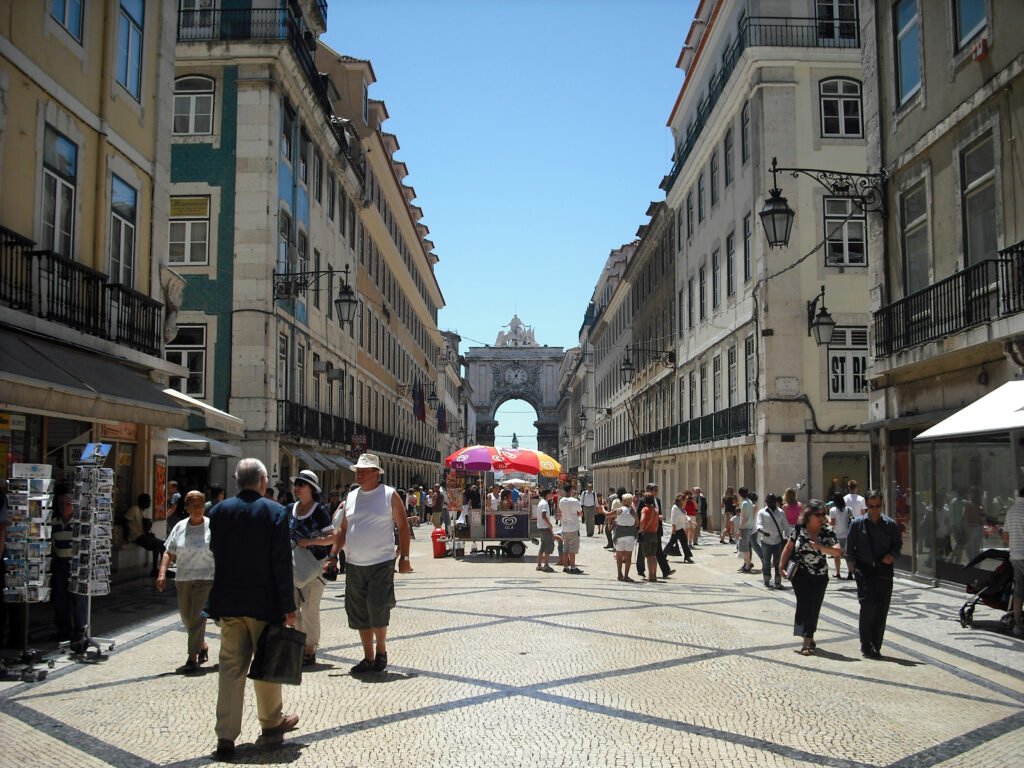
Lisbon’s central visitor districts sit unusually close together, but they occupy very different elevations and street forms. Baixa provides the calmest geometry, with Rossio, Praça da Figueira, and Praça do Comércio linked by a legible grid. Chiado and Carmo rise immediately west, while Alfama and the castle climb sharply east. That means map distance often understates physical effort without changing the underlying compactness. Belém behaves differently, forming a separate western cluster that is better reached by tram or rail. The most efficient weekend alternates dense central walking with selective transit, avoiding repeated climbs that add little sightseeing value.
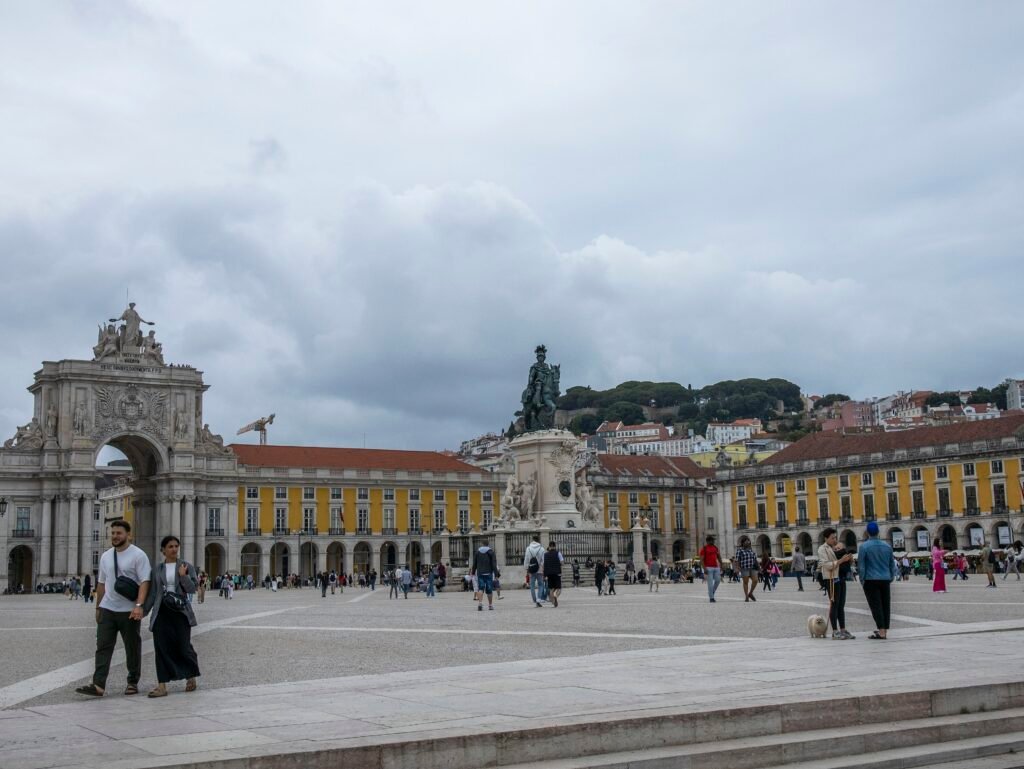
Why Lisbon Works Well on Foot
The strongest walking system runs through Rossio, Praça da Figueira, Baixa, Praça do Comércio, Chiado and Carmo. These places are genuinely close together, even when the climb between them is not easy. Official accessibility guidance describes Rossio as flat with regular paving and lowered crossings. It also describes Rua Augusta as fully pedestrian, with Praça do Comércio continuing the broad lower-city space.
That central strength changes quickly east and west. Chiado and Carmo rise above Baixa, while Sé, Alfama and Castelo de São Jorge occupy the eastern slopes. Alfama still feels like a natural walking extension of Baixa because the districts touch directly. Its narrow lanes, stairs and irregular routes simply make the same short geography more demanding.
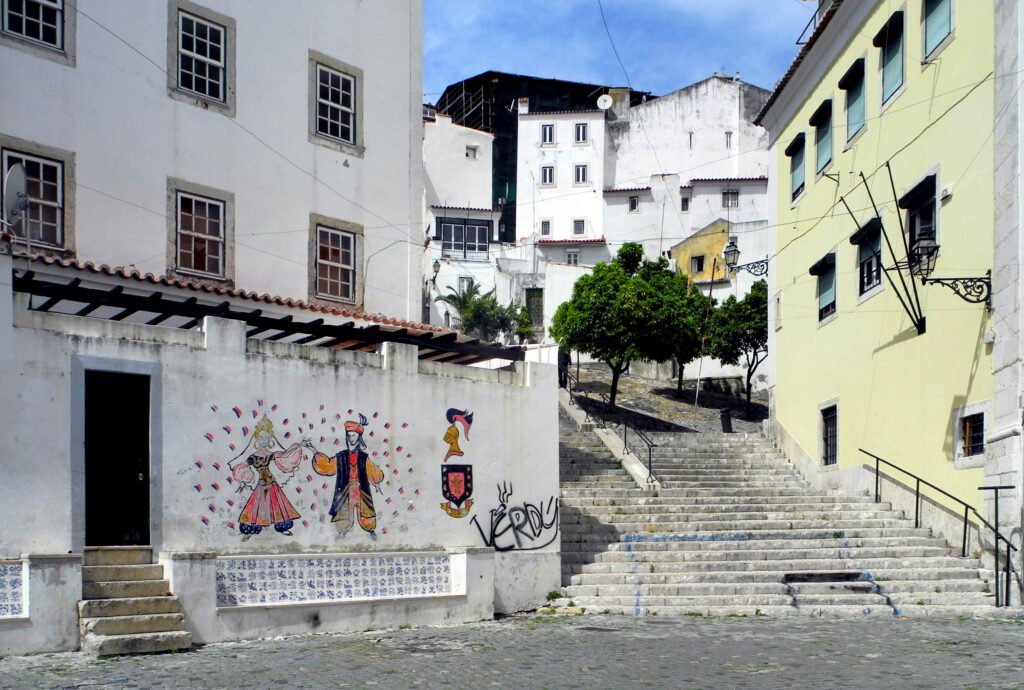
Where the Walking Gets Harder
Lisbon’s hills are not a reason to downgrade the city’s central compactness. They are a reason to route the compact center intelligently. The common climb from Baixa toward the castle uses steep streets, and official guidance describes continued incline even after public elevators reduce elevation.
Historic calçada also deserves a practical reading. It can be attractive and comfortable on well-maintained, broad surfaces such as central Baixa. Elsewhere, uneven stones, stair streets, narrow lanes and tram tracks require more attention. Travelers using small suitcase wheels, strollers or mobility aids should plan surfaces as carefully as distances.
Best Areas to Stay for Walking
Baixa and Rossio are the easiest choices for minimizing hills. Praça do Comércio, Rua Augusta, Rossio and Praça da Figueira are immediately walkable, with Chiado and Alfama close by.
Chiado and Praça Luís de Camões offer the best balance between central access and an elevated starting position. They work especially well for travelers comfortable with short steep streets.
Lower Avenida da Liberdade and Restauradores provide a straightforward northern edge to the core. Staying farther north increases walking distance to Alfama and the riverfront.
Bairro Alto edges and Alfama can be excellent bases, but luggage changes the equation. A hotel may be geographically central while still requiring steep approaches, stairs or rougher paving.
Useful Lisbon Walking Times
Rossio to Praça do Comércio takes about 10–12 minutes through the largely level Baixa grid. Rossio to Carmo is only 6–8 minutes, but the climb is much more noticeable.
Rossio to Chiado is roughly 8–12 minutes uphill. Praça do Comércio to Sé is about 8–10 minutes, with the eastern climb beginning almost immediately.
Sé to Santa Luzia takes about 7–10 minutes uphill. From Santa Luzia or Portas do Sol, the castle entrance is roughly 5–8 minutes away.
The castle publishes an approximately 11-minute route from Rossio Metro using the Chão do Loureiro public-lift approach. These are practical planning estimates rather than guaranteed walking times.
A 2-Day Walking Route
Day 1: Chiado, Carmo, Baixa and the River
Walking route
Day 1 — Chiado downhill through Baixa to Cais do Sodré
- Praça Luís de Camões
- Largo do Chiado
- Carmo Convent
- Rossio Square
- Praça da Figueira
- Arco da Rua Augusta
- Praça do Comércio
- Cais do Sodré Station
Begin around Praça Luís de Camões and Chiado, then make the short connection to Carmo before descending. Continue through Rossio, Praça da Figueira and Rua Augusta to Praça do Comércio. Finish west at Cais do Sodré. This order turns the day into a mostly downhill-then-level walk instead of repeatedly climbing back toward Chiado.
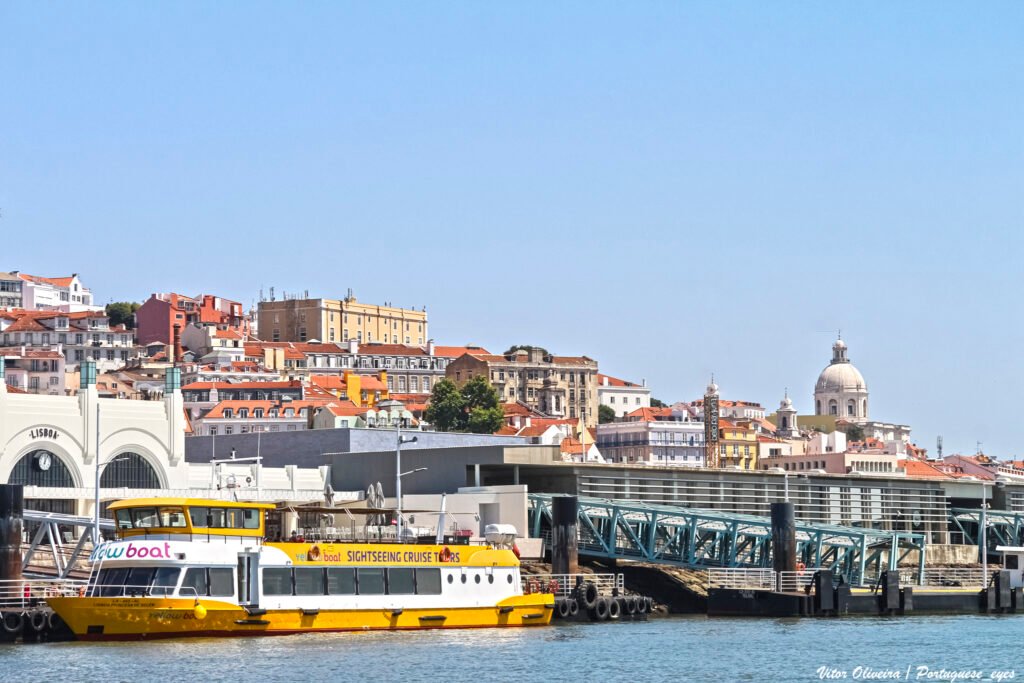
Day 2: Castelo, Alfama and Belém
Walking route
Day 2 — Castelo and Alfama downhill, then Belém
- Castelo de São Jorge
- Miradouro das Portas do Sol
- Miradouro de Santa Luzia
- Lisbon Cathedral
- Campo das Cebolas
- MAAT
- Jerónimos Monastery
- Padrão dos Descobrimentos
- Belém Tower
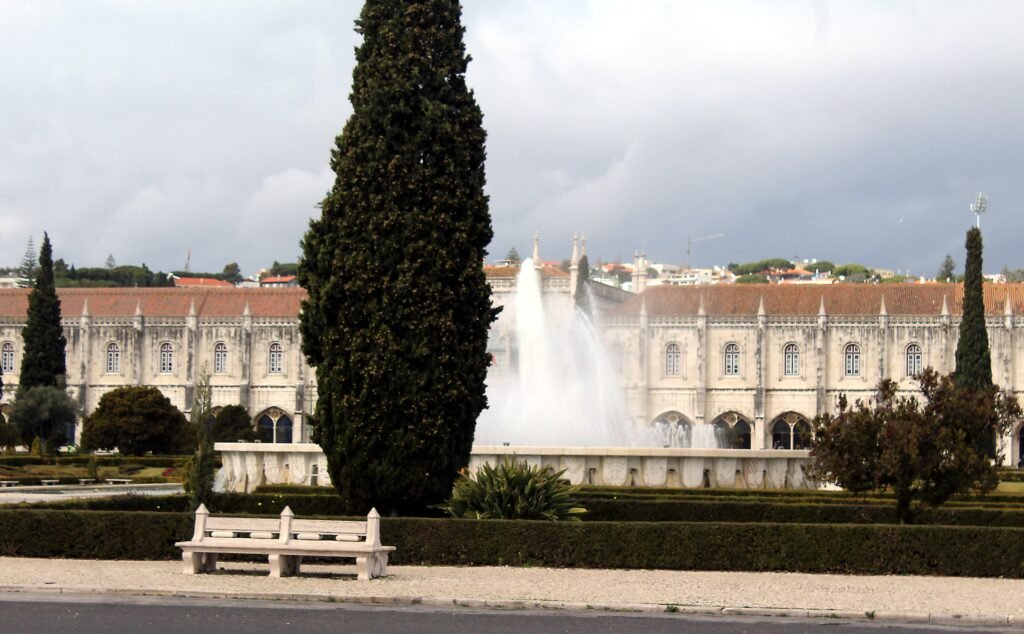
Start at castle height using the Baixa public elevators or Bus 737, then descend once through Portas do Sol, Santa Luzia and Sé. Continue toward the river and walk west to Praça do Comércio. Tram 15E then handles the cross-city jump to MAAT, leaving a coherent western walk through Jerónimos, the riverfront and Belém Tower.
When Transit Helps Most
Metro is most useful for airport arrival, Avenida da Liberdade, Baixa-Chiado access and longer cross-city trips. Tram 15E is particularly useful for reaching Belém, while Tram 28E can save effort across some of the steeper central corridors. CP rail from Cais do Sodré provides another practical option for Belém and the western waterfront. Check current Metro, Carris and CP timetables before travel.
Vertical Transport: Check Current Service
Lifts and funiculars can reduce the effort of steep routes, but temporary closures and maintenance are common enough that they should not be treated as guaranteed parts of an itinerary. Check current Carris service before relying on Santa Justa, Bica, Glória, Lavra or the Graça Funicular. When operating, these services save climbing effort without changing the underlying terrain.
Tickets and Contactless Payment
For occasional visitors, single-journey and time-based tickets cover Carris and Metro, with additional products available when CP urban rail is included. Navegante cards and contactless payment provide convenient options. Because fares and payment rules can change, check current Carris and Metro ticket information before travel.
Arriving in Lisbon Without a Car
Lisbon Airport has a Metro station on the Red Line, making public-transport arrival straightforward. Most Baixa and Chiado stays require a transfer rather than a direct ride, while Oriente provides an important connection with the national rail network. Check the current Metro journey planner for your exact destination.
Oriente is a major national rail gateway and connects directly with the Metro. Santa Apolónia remains important for north-axis rail, including Porto services. Rossio mainly serves the Sintra corridor, while Cais do Sodré serves Belém and Cascais.
When a Car Helps
A car adds little to the standard Lisbon city weekend. Central streets, hills, parking and dense transit make walking plus public transport more practical for the main visitor areas.
Sintra and Cascais are separate excursions, not extensions of Lisbon’s walking core. Both have strong rail access and should be treated as separate excursions rather than extensions of central Lisbon. A car becomes more useful for dispersed regional trips beyond the strongest rail corridors.
Walking Limitations and Practical Tips
Plan elevation before distance. One well-sequenced climb can be enjoyable; several unnecessary down-up-down movements can dominate the day. Starting high and walking downhill works particularly well for Alfama and the castle.
Wear shoes with dependable grip and cushioning. Calçada can be smooth, irregular or broken depending on the street, and tram rails add another surface change. Keep extra time for crowds around Rua Augusta, Rossio, Sé and major viewpoints.
Seasonal Walking Note
Summer heat and direct sun can make hillside routes feel substantially harder than the same distance in mild conditions. Rain can make polished stone feel slick. These conditions change walking comfort rather than Lisbon’s underlying distances and connections. Shift steep sections earlier, carry water and use transit when weather makes a low-value climb unattractive.
Bottom Line
Lisbon works best as a compact central walking city with selective transit for elevation and outer clusters. Baixa, Rossio, Chiado, Carmo and Alfama are close enough to connect naturally, while Belém deserves its own transit-supported segment. The key planning choice is not whether destinations are nearby, but how often you ask your legs to cross the same vertical difference.