
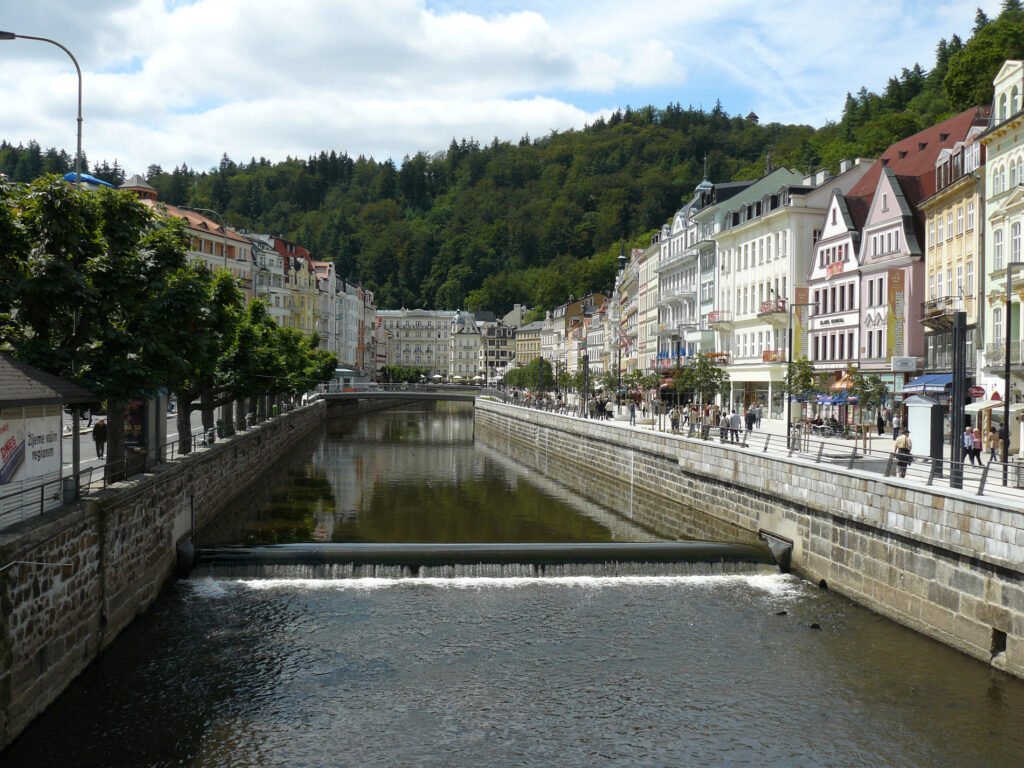
Karlovy Vary stretches its visitor core along the Teplá instead of gathering everything around one square. The main colonnades sit sequentially beside the river, with short bridges tying both banks into one walking corridor. Hot Spring, St. Mary Magdalene Church, Market Colonnade, and Mill Colonnade are only minutes apart. Grandhotel Pupp extends that same level promenade south rather than creating a separate district. The pattern changes above the valley floor, where Westend streets, hillside hotels, and Diana introduce sustained climbing. Rail and coach gateways also sit outside the strongest spa streets. This makes the city easy to walk lengthwise, but less forgiving when elevation enters the day.
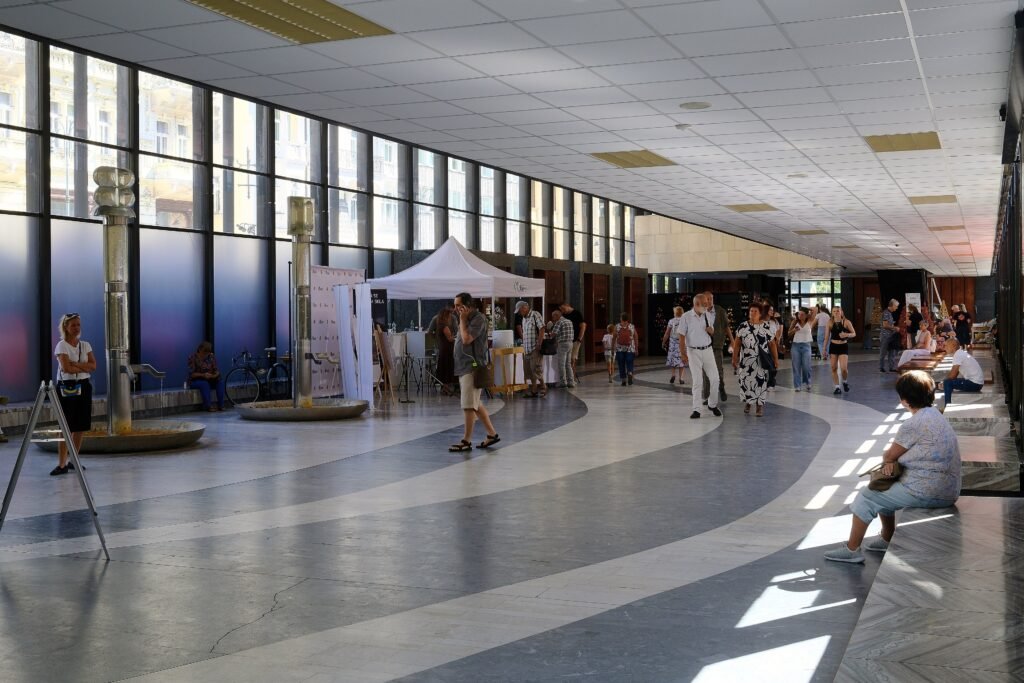
Why Karlovy Vary Works Well on Foot
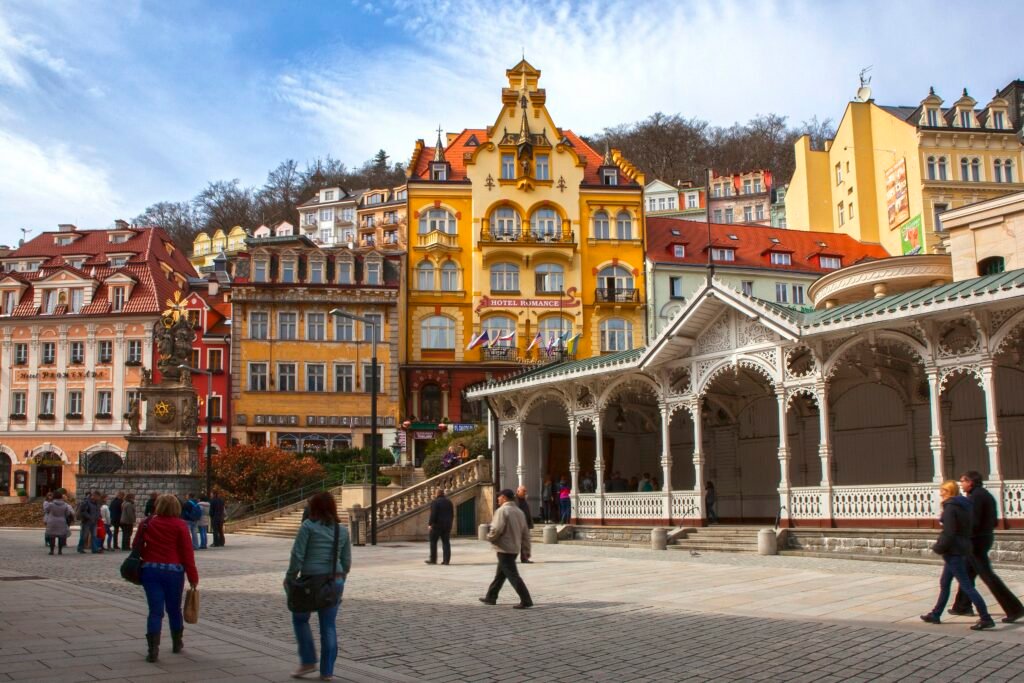
Karlovy Vary’s shape is long, but its first-visit sights are not widely scattered. Hot Spring sits about five minutes from Market Colonnade, ten minutes from Mill Colonnade, and fifteen minutes from Park Colonnade. St. Mary Magdalene Church is roughly 100 metres from Hot Spring. In the opposite direction, the level riverside walk to Grandhotel Pupp takes just under ten minutes. Those distances create a continuous sightseeing line rather than disconnected pockets.
The Teplá also divides the centre less than a map might suggest. Jánský Bridge links Hot Spring with Market Street, and the rebuilt Spa Bridge carries broad sidewalks near Lázně III. Other short crossings let visitors switch banks without major detours. The river acts more like the organising spine of the spa centre than a barrier between neighborhoods.
That coherence has clear limits. Westend begins to climb above the valley, Diana rises sharply behind the Pupp area, and Moser sits well west of the spa corridor. Strong bus coverage makes those places easy to add, but it does not make them part of the same pedestrian geography.
Best Areas to Stay for a Walking Weekend
The easiest bases sit directly along the Teplá between Park Colonnade and Grandhotel Pupp. Around Mill Colonnade, Market Colonnade, Hot Spring, Stará Louka, and Nová Louka, most headline sights remain on the same level walking spine. The official accommodation directory includes substantial hotel capacity inside that geography, including properties directly opposite Mill Colonnade.
Westend can still be a good base, especially near the Orthodox Church, but the daily effort changes. The neighborhood overlooks the centre rather than sharing its river-level terrain. Hilltop properties around Imperial create the same tradeoff: map distance may be short, while repeated climbs can make buses or the Imperial funicular part of the routine.
Realistic Walking Times
- Hot Spring to Market Colonnade: about 5 minutes and 200 metres, using a short bridge crossing.
- Mill Colonnade is about 10 minutes and 500 metres from Hot Spring through the spa centre.
- Park Colonnade is about 15 minutes and 800 metres from Hot Spring along the main valley corridor.
- St. Mary Magdalene Church is roughly 2–4 minutes from Hot Spring, with a short rise above river level.
- Grandhotel Pupp is just under 10 minutes from Hot Spring on an officially described level 500-metre route.
- The Orthodox Church is roughly 15–20 minutes from Hot Spring for most visitors, with a sustained uphill section.
- Grandhotel Pupp to the Diana lower station takes only a few minutes, but the summit itself is vertically separated.
These are practical planning estimates rather than guaranteed walking times. Historic paving, crowds, stairs, luggage and individual mobility can change the comfortable pace.
A 2-Day Walking Route
The two days use different terrain. Route one stays almost entirely on the Teplá valley floor and demonstrates the city’s strongest walking geography. The second route concentrates the major climbing around Diana and Westend, avoiding repeated hill work on both days.
Day 1: Park Colonnade to Imperial Spa
Walking route
Day 1: Park Colonnade to Imperial Spa
- Park Colonnade (Sadová kolonáda)
- Mill Colonnade (Mlýnská kolonáda)
- Market Colonnade (Tržní kolonáda)
- Hot Spring Colonnade (Vřídelní kolonáda)
- Church of Saint Mary Magdalene
- Divadelní náměstí (Theatre Square)
- Grandhotel Pupp
- Imperial Spa (Císařské lázně)
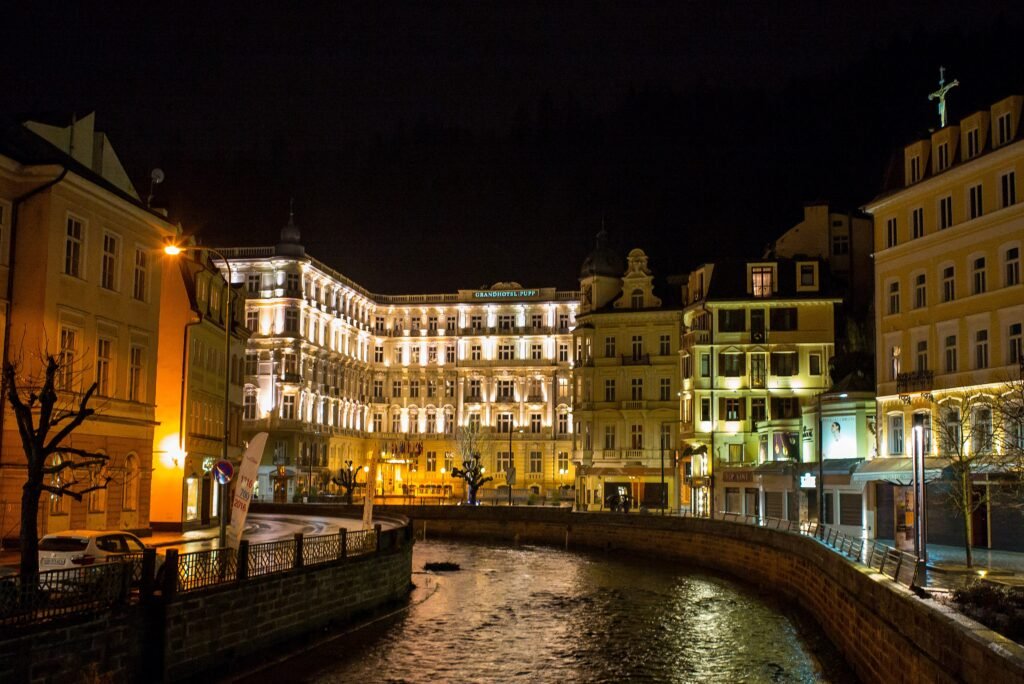
Begin at Park Colonnade and move south toward Mill Colonnade. Continue through Market Street to Hot Spring, then make the short rise to St. Mary Magdalene Church. From Theatre Square, follow the Teplá toward Stará Louka and Grandhotel Pupp. Finish beside Imperial Spa and Charles IV Park. Almost every transfer between major stops adds sightseeing value, so there is little reason to insert a bus.
This route also shows why Karlovy Vary’s linear form is not a weakness. A traditional old-town loop would add little here. Moving in one direction lets the colonnades, bridges, riverbanks, spa streets, and southern hotel district unfold naturally without backtracking.
Day 2: Diana, Forest Paths and Westend
Walking route
Day 2: Diana, forest paths and Westend
- Grandhotel Pupp
- Diana Funicular Lower Station
- Diana Observation Tower
- Peter's Height Lookout (Petrova výšina)
- Orthodox Church of Saint Peter and Paul
Start beside Grandhotel Pupp and walk a few minutes to the Diana lower station. As of September 2, 2026, the funicular is closed for track repairs through September 25. The current walking route therefore climbs to Diana on marked paths rather than pretending the summit is an effortless extension. The observation tower and summit attractions remain open.
After Diana, descend through the spa woods toward Peter’s Height and continue toward Westend and the Orthodox Church. Forest paths, stone steps and sustained gradients make this substantially harder than Day 1. Check the current Diana funicular status before travel if you want to reduce the ascent.
Using Public Transport in Karlovy Vary
DPKV buses are most useful for the railway stations, Tržnice, hillside accommodation, Moser and other destinations beyond the central spa corridor. Contactless payment is available across the network, with time-based tickets for occasional journeys. Check current DPKV fares and validity rules before travel.
Diana is a specialized hill connection rather than ordinary city transport. Its operating status, timetable and fare should be checked separately before visiting. Even when the funicular is running, the surrounding hillside remains much steeper than the valley-floor spa streets.
Arriving in Karlovy Vary Without a Car
Prague Airport is a practical international gateway for many visitors, with direct coach connections available toward Karlovy Vary. Services generally stop at the main Terminal or Tržnice, giving convenient access to the city without first entering central Prague. Check current coach schedules before travel.
Direct rail services also connect Prague with Karlovy Vary, though the journey can take longer than the coach. Rail remains useful for travelers already in central Prague or arriving from other rail-served Czech cities.
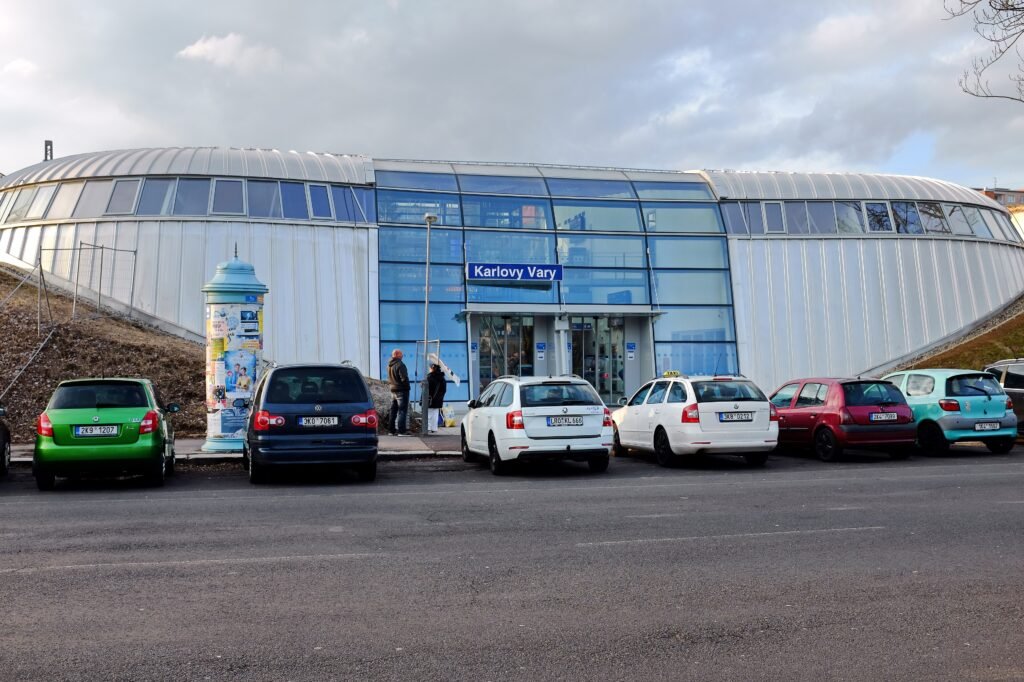
The main railway station is not inside the colonnade corridor, so luggage can make a short DPKV ride worthwhile. Lines 4 and 11 integrate Horní nádraží with Tržnice and the spa-centre edge. Dolní nádraží remains useful for regional services, but it is a separate local gateway rather than a second arrival bonus.
Karlovy Vary Airport is locally easy to reach by city bus 8, but its September 2026 scheduled network is small. Seasonal Antalya, Burgas, and weekly Tashkent flights do not represent the normal international arrival pattern. Its geographic closeness therefore does not outweigh Prague Airport’s much broader relevance.
When a Car Helps
A private car adds little to the standard Karlovy Vary city weekend. The spa zone restricts vehicle access, central sightseeing is concentrated, and buses cover the main gateways, hills, and Moser. Driving becomes more useful when the trip expands into several dispersed regional stops that are awkward to combine by public transport.
Loket, Mariánské Lázně, Františkovy Lázně, Bečov nad Teplou, Jáchymov, and Prague are separate excursions. Their accessibility says nothing about Karlovy Vary’s internal attraction proximity. Keep them outside the city walking maps and compare them only when planning the wider region.
Walking Limitations and Practical Tips
The easiest mistake is to read short horizontal distances as easy walks. Westend, Diana, hillside hotels, and forest lookouts can sit close to the river on a map while requiring substantial elevation. Group those climbs together instead of descending to the valley and climbing again several times.
Inside the spa centre, use the river as the main orientation line. Bridges are frequent enough that there is little value in forcing yourself to stay on one bank. Covered colonnades can provide welcome shelter, but historic paving and stairs still matter for travelers with luggage, wheelchairs, strollers, or limited mobility.
Temporary construction can occasionally alter pedestrian routing around the Hot Spring area or other spa-center streets. Check current local notices before travel when major works are underway, but these short-term changes do not alter the overall valley walking pattern.
Seasonal Walking Note
Rain is partly softened by covered colonnades and the short distances between central sights. Winter snow or ice matters more on Westend streets, Diana paths and other steep approaches, while summer visitors may prefer shaded river and forest sections. These conditions change walking comfort rather than the city’s basic distances and connections.
Bottom Line
Karlovy Vary is at its best when the weekend is planned by elevation, not by arbitrary districts. Spend one day moving lengthwise through the spa valley, where the principal attractions sit unusually close together. Use the second day for Diana and Westend, then let DPKV handle low-value gateway mileage or steeper returns. A central valley-floor base keeps most of the trip on foot without pretending the surrounding hills are flat.