
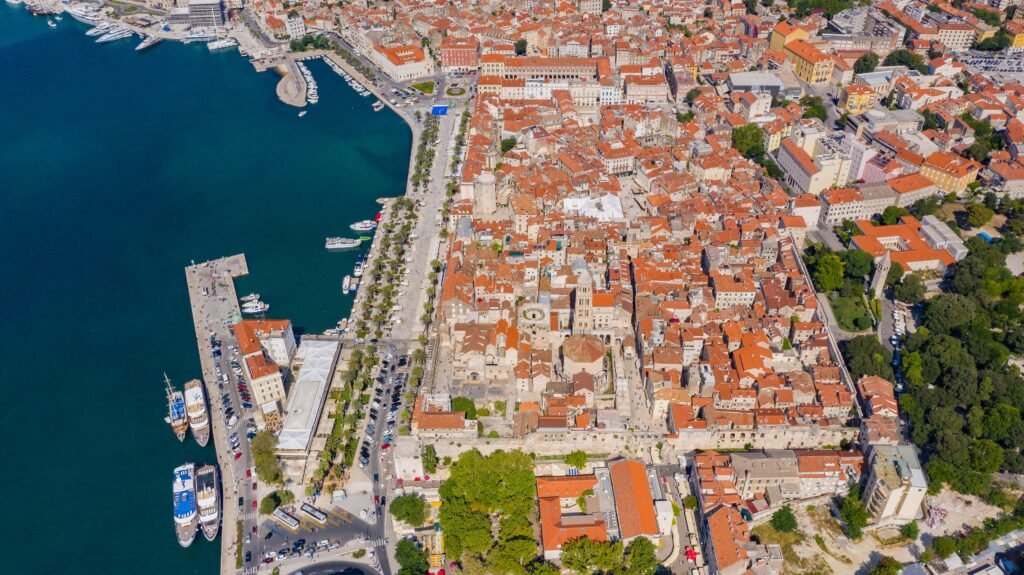

Split compresses its historic core into a remarkably small area, but the weekend footprint quickly stretches beyond the palace walls. Diocletian’s Palace opens directly onto Riva, while Pazar, Pjaca, Marmontova, and Republic Square cluster within minutes. Bačvice extends the same walking pattern eastward beyond the ferry and bus terminals. Westward, Veli Varoš starts the climb toward Marjan, where viewpoints, galleries, beaches, and forest paths spread farther apart. That contrast defines Split better than its palace core alone. Most sightseeing stays walk-first, but a few well-chosen bus rides can save substantial distance and climbing.

Why Split Works Well on Foot
Diocletian’s Palace is not a detached monument reached from the city center; it is the city center. Its main Roman axes still organize movement through gates, courtyards, narrow lanes, shops and homes. Riva runs along the palace’s southern edge as a broad, flat promenade, while Pazar sits immediately east. Pjaca, Marmontova and Republic Square continue the visitor chain west without requiring transit. The official tourism board’s one-day route links the same sequence before extending toward Veli Varoš, Marjan or Bačvice. That compactness is real, but it describes only the strongest central cluster.

The pedestrian environment changes by block. Inside the palace, visitors encounter ancient paving, steps, tight passages and irregular historic surfaces rather than modern sidewalks. Marmontova and Riva are much easier, with generous pedestrian space and obvious orientation landmarks. Around the port, traffic and terminal activity become more noticeable. Bačvice remains a straightforward eastern walk, while Veli Varoš introduces steep stone streets before the routes climb onto Marjan.
Where to Stay for a Walking-First Trip
The best base is usually just outside or along the edge of the palace rather than deep inside its narrowest lanes. Old Town and the Riva put the largest number of sights within a few minutes, but expect crowds and luggage-unfriendly stone surfaces. Lučac works especially well for travelers arriving by bus or ferry and still keeps the palace close. Bačvice adds beach access while remaining walkable to the center. Veli Varoš is ideal for Marjan access and atmosphere, but its slopes and steps make it a less effortless base for travelers with heavy bags or limited mobility.
Walking Times Between Major Split Sights
Use these as practical planning estimates rather than live-navigation guarantees. Peristyle to Riva is roughly five minutes, and Peristyle to the Green Market is similarly short. Riva to Republic Square takes about five to seven minutes through the western core. The palace area to Bačvice is usually around 15 minutes, depending on the starting gate. From the western Riva, Prva Vidilica above Veli Varoš is about 15–20 minutes uphill. Meštrović Gallery is a longer western extension, roughly 30–40 minutes from the palace area on foot.
A 2-Day Walking Route
Day 1: Bačvice, Diocletian’s Palace and the Waterfront
Walking route
Day 1: Bačvice, Diocletian’s Palace and the waterfront
- Bačvice Beach
- Split Main Bus Station and Ferry Port
- Green Market (Pazar)
- Silver Gate
- Peristyle
- Cathedral of Saint Domnius
- Vestibule of Diocletian's Palace
- Diocletian's Cellars
- Riva
- Fruit Square
- People's Square (Pjaca)
- Marmontova Street
- Republic Square (Prokurative)
- Matejuška

Start at Bačvice and walk west toward the harbor, keeping the day moving in one direction. Pass the ferry and intercity-bus terminals, then enter Pazar and the palace through the Silver Gate. Continue through Peristyle, the Cathedral area, Vestibule and palace cellars before reaching Riva. From there, move through Fruit Square and Pjaca, then continue along Marmontova to Republic Square. Finish at Matejuška for the western waterfront. This route captures the compact core without wasting time on cross-city transfers or repeated backtracking.
Day 2: Veli Varoš and Marjan
Walking route
Day 2: Veli Varoš and Marjan
- Church and Monastery of Saint Francis
- Veli Varoš
- Prva Vidilica
- Church of Saint Nicholas on Marjan
- Marjan southern promenade
- Meštrović Gallery
- Sustipan Park
- West Coast promenade
- Riva
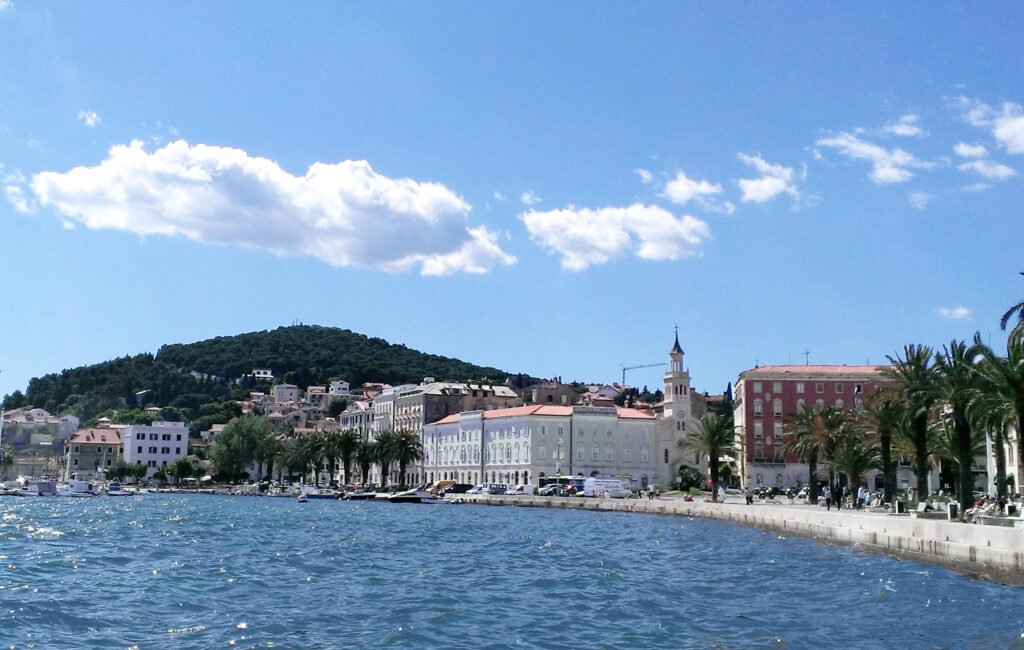
Begin near Saint Francis at the western end of Riva and climb through Veli Varoš to Prva Vidilica. Continue toward Saint Nicholas Church and the southern Marjan paths, where the city center quickly gives way to wooded slopes and viewpoints. Descend toward Meštrović Gallery, then continue through Sustipan and the West Coast promenade back toward Riva. The loop is much more demanding than Day 1, but it avoids turning Marjan into an out-and-back climb. Travelers wanting Bene or deeper forest stops should use Bus 12 for one leg instead.
When Split Buses Are More Useful Than Walking
Central sightseeing rarely needs a bus. Transit becomes valuable when the destination itself is outside the palace–Riva–Bačvice walking cluster. Promet’s city network serves the ferry-port area, Žnjan, Marjan and Bene, plus wider residential districts. Line 12 is the key Marjan service from the western center toward Bene. Promet confirmed that the line returned to its normal Bene routing on October 27, 2026, after a temporary change. Check the live timetable before relying on a specific departure, especially on weekends or late in the day.
Arriving in Split Without a Car
Split has an unusually convenient central arrival layout. The main intercity bus station sits beside the city port and railway station, only a short walk from the palace. Ferry passengers can therefore arrive almost directly into the sightseeing zone. Split Airport is the main exception because it lies about 20 kilometers away near Kaštela. The airport operates a direct shuttle to Split Main Bus Station throughout the day, while Promet also lists public-bus alternatives. In summer, road congestion can make the airport transfer slower than the distance suggests.
When a Car Helps
A car adds little inside central Split and can become a burden around the palace and port. It becomes more useful for regional trips such as inland Dalmatia, remote beaches, smaller coastal settlements or itineraries combining several places beyond the urban bus network. Island trips are a different case: the ferry port is already beside the center, so a private car is unnecessary for many passenger-ferry day trips. For a two-day city break focused on Split itself, walking plus occasional buses is the more practical combination.
Walking Limitations and Practical Tips
Do not judge Split only by the effortless Riva and palace core. Historic paving, steps and tight alleys can slow travelers with luggage, strollers or limited mobility, even where distances are tiny. Veli Varoš and Marjan add real elevation. The port approaches mix large pedestrian flows with buses, taxis and ferry traffic. In peak visitor periods, Peristyle and the narrowest palace lanes can become crowded enough to reduce walking speed. Comfortable shoes matter more on the old stone than the short distances suggest.
Seasonal Walking Context
Split’s structural walkability does not change by season, but comfort does. Summer heat, strong sun and large visitor volumes make the exposed Riva and Marjan climbs more tiring. Earlier starts work better for hills, while the palace lanes provide more shade than the waterfront. Cooler months reduce heat stress and crowds, but shorter daylight and wet historic stone can change how much ground feels comfortable. Treat those conditions as trip-planning context rather than reasons to redefine the city’s underlying pedestrian geography.
Bottom Line
Split is strongest when a weekend is organized around its central pedestrian spine rather than around every attraction on the peninsula. Diocletian’s Palace, Riva, markets, central squares and Bačvice fit naturally into walking days. Marjan is still accessible on foot, but its slopes and longer western distances are the city’s main walking trade-off. Stay close to the palace, use buses selectively for deeper Marjan or outer beaches, and the city works very well without a car.