


Rijeka’s visitor geography is a long, low waterfront core interrupted by hills that rise almost immediately behind it. Korzo, City Tower, the Old Town, market halls, theatre, and passenger waterfront sit within a tight central band. A second cultural cluster around Sugar Palace and the modern art museum extends west toward the railway station. North of Korzo, museums and civic buildings require shorter uphill approaches. Trsat changes the scale completely, rising across the Rječina above the center. Reaching the castle on foot means a deliberate climb, not another casual central-city stroll. That contrast defines a weekend here: compact lower-city walking, plus selective bus use for elevation.
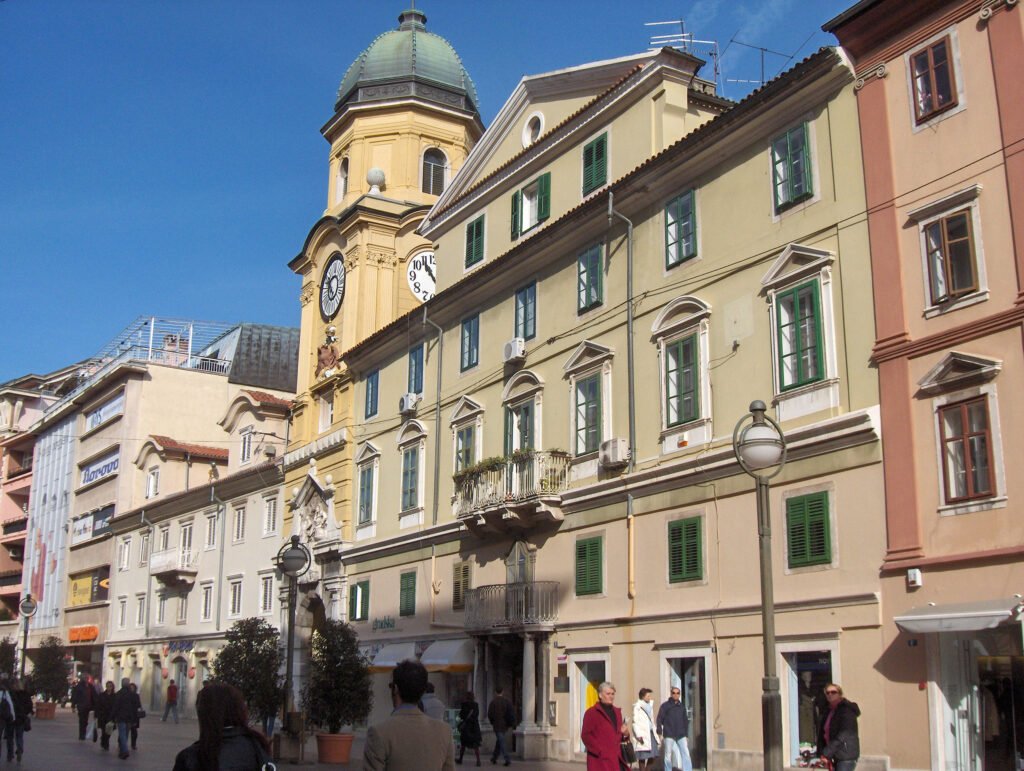
How Rijeka’s Lower-City Core Works on Foot
Korzo does most of the organizing. The City Tower opens directly into the Old Town, where Kobler Square, Principia and St. Vitus sit within short lanes. South of Korzo, the market pavilions and Croatian National Theatre occupy the same compact waterfront district. The port edge stays close enough that sightseeing rarely needs a bus here.
The strongest pedestrian conditions are concentrated rather than citywide. Korzo is a formally defined pedestrian zone, while the Old Town and market streets keep many short hops away from heavy traffic. Molo Longo adds a flat, two-kilometre breakwater promenade. It is easy walking physically, but completing the full pier adds meaningful out-and-back mileage.
The Museum Clusters Extend the Center Without Breaking It
West of Korzo, Sugar Palace and the Museum of Modern and Contemporary Art share the Benčić cultural quarter near the railway station. This extension remains practical on foot and works especially well for travelers staying around Brajda or Žabica. It also makes rail arrival unusually convenient for a museum-first afternoon.
North of Korzo, the Natural History Museum and Governor’s Palace sit close by map distance but require some climbing. The Maritime and History Museum currently lists Governor’s Palace as closed for energy renovation. Treat the palace as an architectural stop until the museum reopens, rather than planning an indoor visit around it.
Trsat Is Close on the Map and Farther in Walking Effort
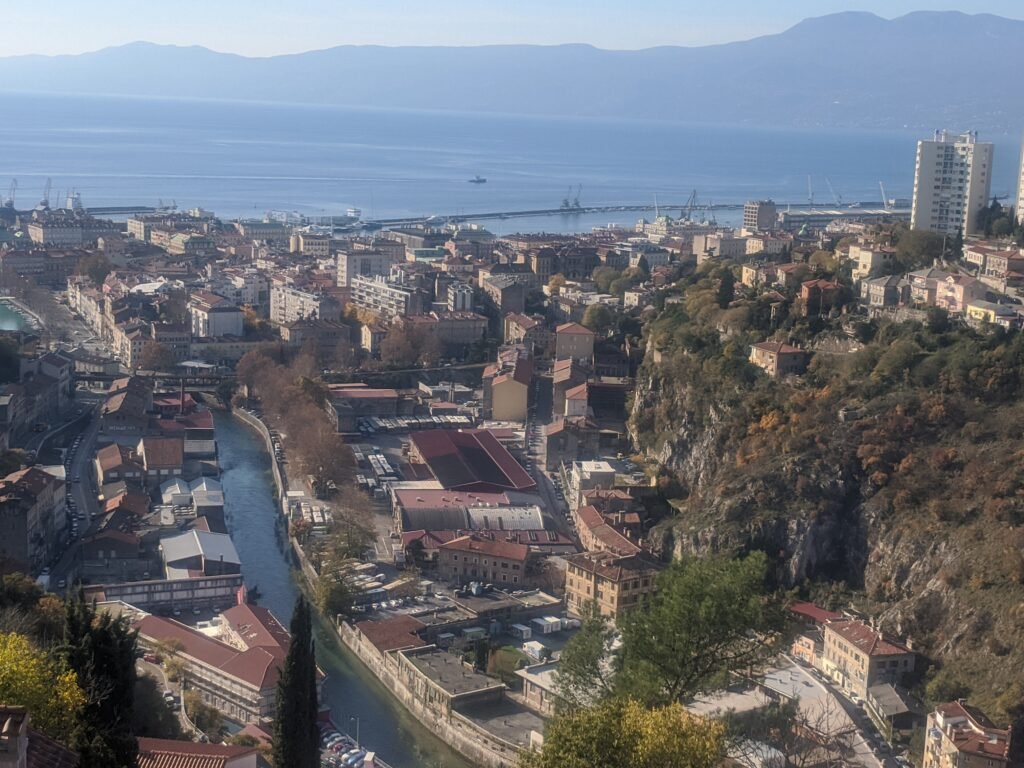
Trsat is the correction every Rijeka walking plan needs. The castle stands 138 meters above sea level, across the Rječina from the lower center. The traditional Petar Kružić approach contains 561 steps. Visit Rijeka describes the climb as roughly twenty minutes for a strong walker, but sightseeing pauses can stretch it.
Bus 2 changes the practical equation without changing the geography. It runs from central stops through the market, Riva, Žabica and railway station to Trsat. Using it uphill preserves energy for the castle, shrine and a downhill stair return. Travelers avoiding stairs can use the bus both ways.
Where to Stay for the Easiest Walking Weekend
- Korzo / Old Town: best for the shortest walks to City Tower, historic lanes, the market and waterfront.
- Žabica / Brajda / Benčić: best for bus or rail arrival, Sugar Palace, MMSU and a short walk into Korzo.
- Fiumara / Rječina: best for the Old Town and easy access to bus 2 or the Trsat stairway.
- Trsat: scenic and quieter, but not the best first-time base if most sightseeing remains in the lower center.
Central accommodation is abundant enough that a private car adds little to hotel logistics. A Korzo address maximizes walkable sightseeing. The western gateway edge is better for luggage-heavy rail or coach arrivals, while Fiumara shortens the Trsat connection.
Useful Walking Times
- Žabica bus station to Korzo: about 5–8 minutes.
- Railway station to Sugar Palace / MMSU: about 5–7 minutes.
- Railway station to central Korzo: about 12–15 minutes.
- City Tower to City Market: about 5–7 minutes.
- City Tower to Sugar Palace / MMSU: about 12–15 minutes.
- City Tower to Governor’s Palace / Natural History Museum: about 7–10 minutes uphill.
- Lower Trsat steps to the shrine: about 20–30 minutes uphill, depending on pauses.
- Trsat Shrine to Trsat Castle: about 5–10 minutes.
- Molo Longo: roughly 25–30 minutes one way for the full two-kilometre promenade.
These are practical planning estimates, not live-navigation guarantees. Hills, crossings, museum entrances and photo stops can add time without changing the underlying geography.
A 2-Day Walking Route
Day 1 — Benčić, the Upper Center, Old Town and Market
Walking route
Day 1: Benčić cultural quarter, upper-center museums, Old Town, market and waterfront
- City Museum of Rijeka — Sugar Palace
- Museum of Modern and Contemporary Art
- Governor’s Palace exterior
- Natural History Museum Rijeka
- St. Vitus Cathedral
- Principia at Tarsatica
- Ivan Kobler Square
- City Tower and Korzo
- Rijeka City Market
- Croatian National Theatre Ivan pl. Zajc
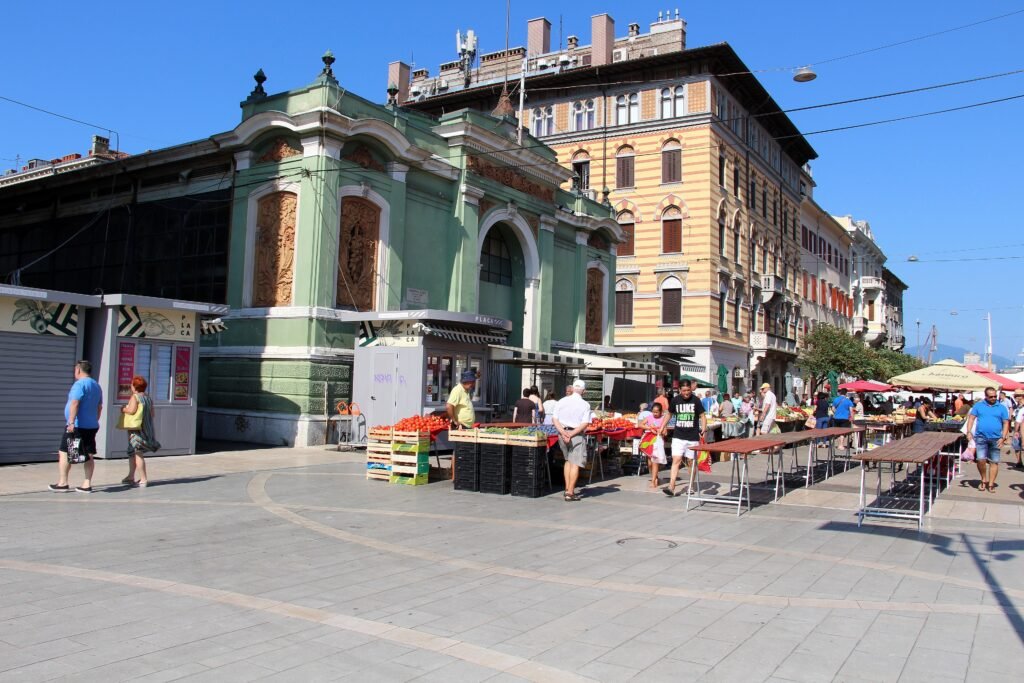
Start at Sugar Palace and the neighboring MMSU, then work east toward Governor’s Palace and the Natural History Museum. Descend through St. Vitus, Principia and Kobler Square before passing under City Tower to Korzo. Finish at the City Market and Croatian National Theatre. This west-to-east sequence avoids repeatedly crossing the central strip and keeps the day mostly within short walking legs.
Day 2 — Trsat Downhill and the Waterfront
Walking route
Day 2: Trsat by bus, one-way downhill walk and Molo Longo
- Trsat Castle
- Shrine of Our Lady of Trsat
- Petar Kružić Stairway — upper section
- Petar Kružić Stairway — lower entrance
- Mrtvi kanal and Rječina waterfront
- Molo Longo
Take bus 2 uphill to the Trsat church area before the mapped walk begins. Visit Trsat Castle first, then the shrine. Descend the Petar Kružić stairway toward Titov trg and continue beside the Rječina and Dead Channel. Finish on Molo Longo if your legs still have another flat waterfront stretch. If stairs are unsuitable, return by bus 2 and join the route at the lower riverfront.

When Rijeka’s Buses Help
Most central sightseeing does not require transit. Autotrolej becomes valuable when elevation or outer districts replace useful sightseeing with effort. The network has 18 city routes, and line 2 is the key visitor service because it links Trsat with Fiumara, Riva, Žabica and the railway station.
Ticketing is straightforward through the RCC Mobility app. A Zone 1 thirty-minute ticket costs €1.30, while a 24-hour pass costs €4.40. The Saturday–Sunday pass costs €7.90. Night routes 102 and 103 operate every Saturday and Sunday, with 102 serving Trsat and the center.
Arriving in Rijeka Without a Car
Intercity Bus
Žabica is the easiest arrival point for most central stays because the bus station is already in the city center. Korzo begins only a short walk away. Coach connections cover Zagreb and many Croatian and international destinations, so bus arrival generally creates little final-transfer burden.
A new West Žabica terminal complex is still an active city project. Current tourism guidance continues to place the operating bus station at central Žabica. Treat the construction as temporary context, and recheck your carrier’s stop before arrival.
Rail
Rijeka railway station sits west of the center at Trg kralja Tomislava. Sugar Palace and MMSU are nearby, while Korzo remains walkable with luggage for many travelers. The current HŽ timetable includes Ljubljana and Zagreb-linked services, although rail frequencies are less flexible than the intercity bus network.
Rijeka Airport
Rijeka Airport needs more planning than its name suggests. The airport is on Krk, not beside the walkable city center. The official shuttle serves Jelačić Square 3, platform 5, and costs €15 one way. Timetables are published monthly, so check the airport schedule against your flight before relying on the transfer.
When a Car Helps
A car is unnecessary for a two- or three-day trip focused on central Rijeka and Trsat. Parking and hill traffic do not improve the strongest sightseeing walks. A car becomes more useful when the trip expands to dispersed Kvarner or Istrian stops, remote beaches, or several regional destinations in one day.
Walking Limitations and Practical Tips
Do not judge the whole city by Korzo. The pedestrian promenade is excellent, but ordinary streets rise quickly behind it. Group upper-center museums together, and avoid adding Trsat as an afterthought after a full lower-city day. That mistake turns a compact itinerary into an unnecessarily tiring one.
The best Trsat strategy depends on your legs. Strong walkers can climb the 561 steps and use bus 2 down. A more energy-efficient weekend does the reverse: ride uphill, visit the castle and shrine, then descend once. Travelers managing stairs should use transit in both directions.
Seasonal Walking Note
Wet or windy conditions matter most on exposed Molo Longo and the long Trsat stairway. Keep a museum-heavy lower-center plan for poor weather and use bus 2 when steps are slick. In warmer periods, the same bus saves energy before the exposed hilltop visit. Seasonal comfort changes pacing, not Rijeka’s underlying geography.
Bottom Line
Rijeka is strongest when treated as two walking experiences rather than one uniformly compact city. Korzo, the Old Town, market, waterfront and western museums form a practical lower-city weekend core. Trsat is genuinely close, but its elevation makes it a separate physical commitment. Use bus 2 strategically, stay central, and reserve private-car travel for regional plans beyond the city.