

From Banegårdspladsen, an 850-meter pedestrian spine leads almost directly toward the cathedral and old center. Strøget continues into Store Torv, while the Latin Quarter and river sit only a few blocks away. Åboulevarden then draws the walk east toward Dokk1, with multiple central crossings preventing the water from dividing the center. ARoS and Musikhuset sit just west of this axis near City Hall, adding little detour. Beyond that compact network, the city begins to stretch. Den Gamle By and the Botanical Garden rise northwest, while Aarhus Ø extends farther along the harbor.

How Aarhus Fits Together on Foot
The most useful first-time walking chain starts at Aarhus H and runs north along pedestrianised Strøget. Store Torv and the Cathedral arrive without a meaningful break, and the Latin Quarter branches immediately north. The river adds orientation rather than a serious barrier because central crossings are close together. Following Åboulevarden east leads naturally toward Dokk1 and the harbor edge. ARoS and Musikhuset form a short western spur near City Hall, so they do not fragment the central itinerary.
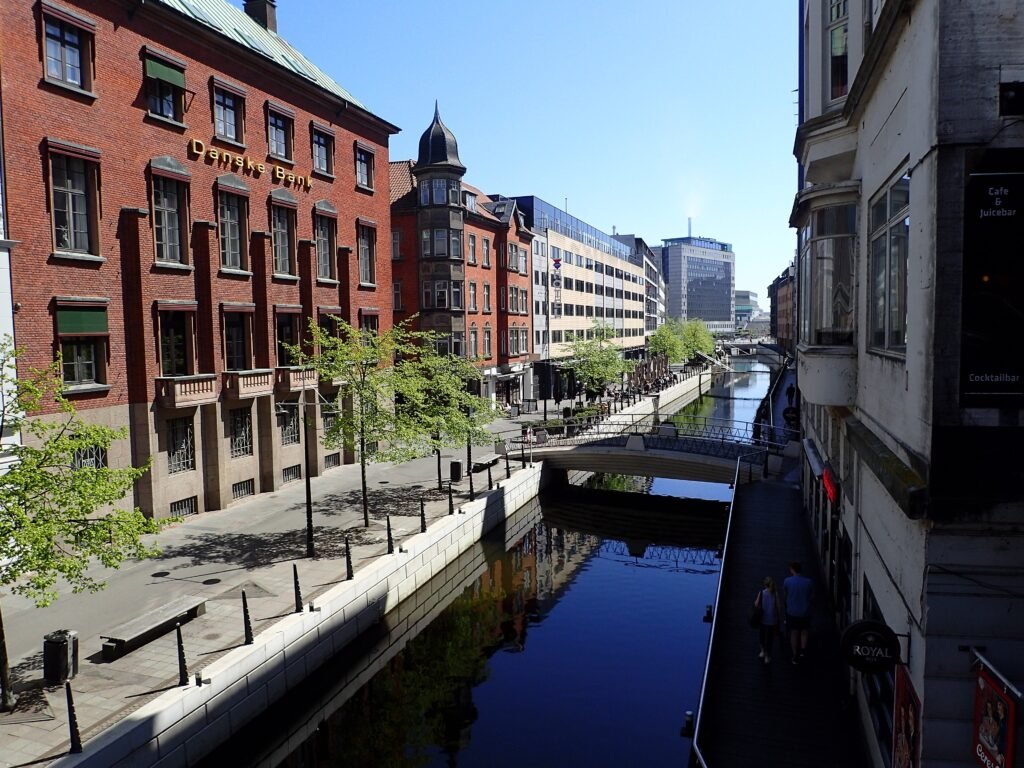
The harbor is more complicated beyond Dokk1. Public-realm changes have removed much of the former road-and-rail separation from the old waterfront. However, Aarhus Ø still reads as a separate extension rather than part of the historic core. Walking there is straightforward through the Navitas side of the harbor, but the extra distance matters over a short weekend.
Best Areas to Stay for Walking
For the easiest first visit, stay between Aarhus H, City Hall, Møllegade and the Latin Quarter. This zone keeps Strøget, ARoS, the Cathedral, the river and Dokk1 within practical walking range. A Latin Quarter base feels more historic, while the station side simplifies luggage and rail arrival. Aarhus Ø is attractive for waterfront stays, but it trades centrality for a longer walk to several classic sights.
Useful Walking Times
- Aarhus H to ARoS: about 10 minutes.
- Aarhus H to Den Gamle By: about 15 minutes.
- Aarhus Cathedral to Den Gamle By: about 15–20 minutes, roughly 1.1 km.
- Dokk1 to Den Gamle By: about 20 minutes, roughly 1.5 km.
- Aarhus H to the northern university area: about 3 km, with noticeable hills.
- Strøget itself runs for about 850 metres through the central pedestrian network.
These are practical planning estimates rather than guaranteed walking times. Hills, crossings, weather and individual pace can change the actual time.
A 2-Day Walking Route
Day 1: Station to Dokk1 Through the Historic Core
Walking route
Day 1 — Station, ARoS, Strøget, Latin Quarter and Dokk1
- Aarhus Central Station (Aarhus H)
- Aarhus City Hall
- Musikhuset Aarhus
- ARoS Aarhus Art Museum
- Strøget / Søndergade
- Store Torv and Aarhus Cathedral
- Latin Quarter / Pustervig Torv
- Mejlgade
- Åboulevarden
- Dokk1
Start at Aarhus H and cross Banegårdspladsen toward City Hall, Musikhuset and ARoS. Then return to the natural northbound line of Strøget rather than cutting across traffic-heavy streets. Continue through Store Torv and the Cathedral before entering the Latin Quarter and Mejlgade. Drop back toward Åboulevarden and follow the river east to Dokk1. The route uses the strongest continuous pedestrian network and avoids wasting distance on outer districts.
Day 2: Den Gamle By to the Harbor Extension
Walking route
Day 2 — Den Gamle By, Botanical Garden and Aarhus Ø
- Den Gamle By
- Botanical Garden and Tropical Houses
- Vesterbro Torv
- Klostertorvet
- Nørreport
- Navitas
- Bassin 7, Aarhus Ø
- Aarhus Ø waterfront
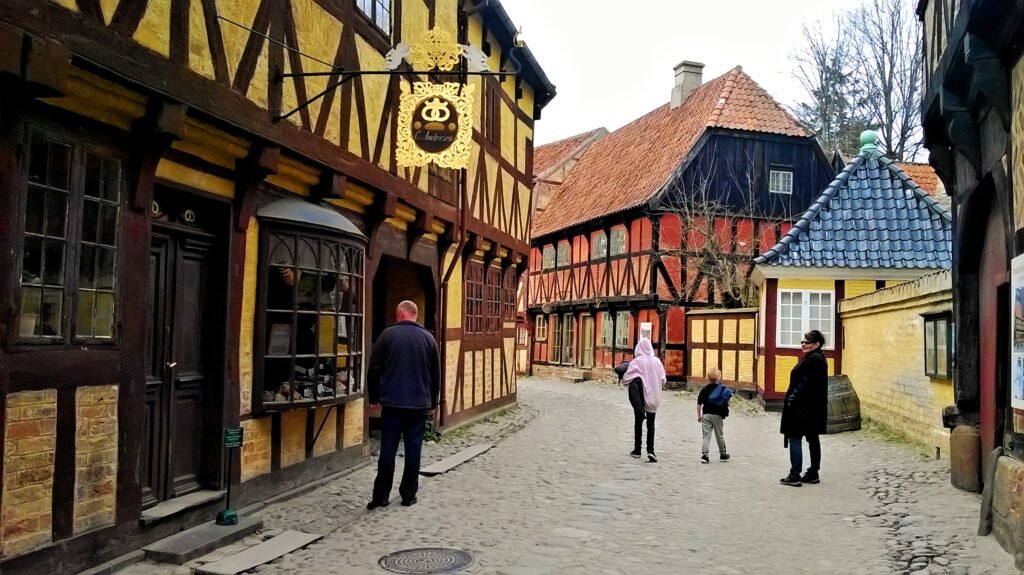
Begin at Den Gamle By before walking next door into the Botanical Garden. From there, descend through Vesterbro Torv and the central north side toward Nørreport. Continue through Navitas and finish along Aarhus Ø. This is the longer walking day and includes more grade change near the start. If you want to conserve energy, a local bus can replace part of the cross-city walk while keeping the same overall itinerary.

When Transit Helps
Aarhus does not need public transport for most central sightseeing, but buses and Letbanen become useful when the itinerary stretches toward Den Gamle By, Aarhus Ø, the university, Marselisborg or other outer areas. Moesgaard is better treated as a separate excursion from the compact central walking network.
Ticketing rules vary between local buses, Letbanen, airport services and rail. Check current Midttrafik information before boarding rather than relying on fixed ticket prices or purchase rules in the guide.
Arriving in Aarhus Without a Car
Billund Airport is a common international gateway for Aarhus, with direct coach services available into the city. The journey is substantially longer than a central rail arrival, so check current airport and Midttrafik schedules before travel.
Rail arrival is especially convenient because Aarhus H sits directly beside the central walking network. Intercity services connect Aarhus with Copenhagen and other Danish cities, while Aarhus Airport provides another air option with onward public transport. Compare current timetables depending on your flight or rail itinerary.
Rail or station works can occasionally alter platforms and timetables at Aarhus H. Check current DSB and Banedanmark notices before travel when your plans depend on a specific service.
When a Car Helps
A private car adds little to a standard central weekend. Strøget, ARoS, the Latin Quarter, Dokk1 and Den Gamle By are easier to combine on foot. Transit also reaches Aarhus Ø, the university and Moesgaard. A car becomes more useful for regional day trips beyond Aarhus, including places where public transport would consume too much limited weekend time.
Limits and Practical Walking Tips
- Expect cobbles and narrower historic surfaces in parts of the Latin Quarter and Møllestien.
- The center and harbor are comparatively easy, but routes toward Vesterbro and the university introduce noticeable climbs.
- Watch bicycle crossings and shared spaces even where the pedestrian network is otherwise excellent.
- Harbor walking is exposed, and wind can make the Aarhus Ø extension feel longer than its map distance.
- Temporary street or station works can occasionally alter the easiest route, so check current local notices when construction affects your itinerary.
Seasonal Walking in Aarhus
The harbor and riverfront can feel exposed in colder, wetter or windier conditions, while long summer daylight makes extended walking days easier. Winter darkness and wet historic surfaces can reduce comfort. Seasonal conditions change the experience rather than the distances between Aarhus’s main visitor areas.
Bottom Line
Aarhus works best as a compact central city with several optional extensions. The station-to-Strøget-to-Cathedral-to-Dokk1 chain is strong enough to carry most first-time sightseeing on foot. Den Gamle By remains an easy walking addition, while Aarhus Ø and the university work better as separate extensions. Use transit selectively, and a private car is unnecessary for a standard two- or three-day city break.