
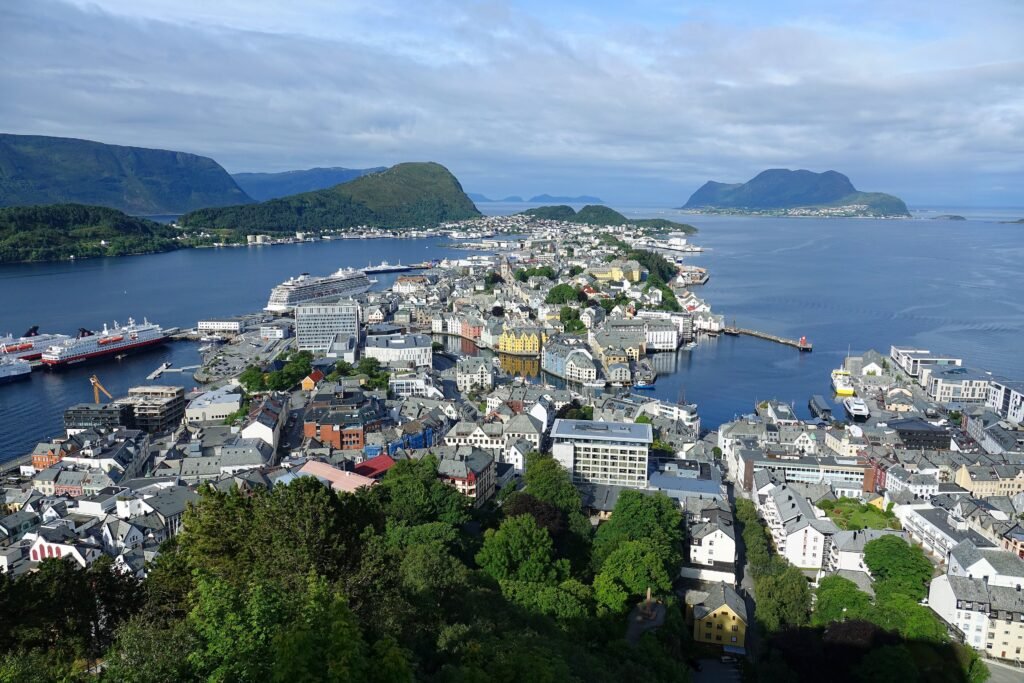

Ålesund wraps its main visitor sights around Brosundet and the adjoining harbor streets, creating an unusually compact walking base. The Art Nouveau Centre, Molja, Ålesund Church, Byparken, and the cruise quays all sit within the same central footprint. Water channels and short bridges shape routes more than distance does. The biggest physical interruption rises immediately behind the center: Aksla is close on the map but demands a 418-step climb. Westward, Atlanterhavsparken stretches the visitor footprint by 3.6 kilometers. That aquarium trip is still practical without a car because bus 1 serves Hessa and stops near the site.
Why Ålesund Works So Well on Foot
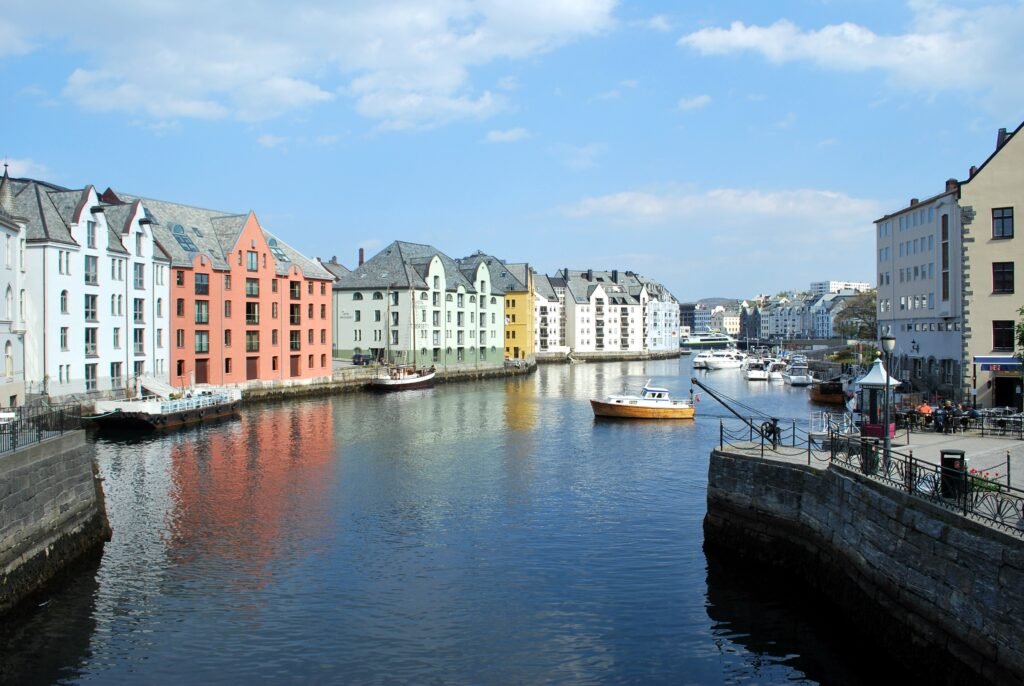
Ålesund’s main advantage is not simply its small size. The visitor core is arranged around a narrow waterfront rather than scattered across separate districts. Fjord Norway places Jugendstilsenteret, Brosundet, Ålesund Church, and the Aksla steps within a 20-minute walk of the cruise quay. Hellebroa links the two sides of Brosundet, while Molja continues naturally from the historic center. Most first-time sightseeing therefore forms one connected chain. Atlanterhavsparken breaks that pattern, but its distance is clear enough to plan around instead of quietly stretching every walking day.
Best Areas to Stay Without a Car
Brosundet and the Art Nouveau center offer the strongest all-round base. Museums, restaurants, the harbor, and Hellebroa sit immediately outside the door. The Kongens gate and Byparken side of the center works well for travelers prioritizing Aksla and central bus stops. Molja and the western side of Aspøya remain very central while feeling slightly removed from the busiest streets. There is little reason to stay farther out for a two-day walking trip unless price or a specific hotel matters more than walking convenience.
Typical Walking Times in Ålesund
Cruise quay to central sights: Jugendstilsenteret, Brosundet, Ålesund Church, and the Aksla steps all fit within about 20 minutes. Brosundet to Byparken: roughly 10–15 minutes through the center. Byparken to Fjellstua: 418 steps, so effort matters more than the short map distance. City center to Atlanterhavsparken: about 45 minutes on foot. Tuenesvegen bus stop to Atlanterhavsparken: about 10–15 minutes. These are planning estimates, not promises for mobility-limited travelers or peak cruise days.
A 2-Day Walking Route
Day 1: Art Nouveau Streets, Molja and Aksla
Walking route
Day 1 — Art Nouveau streets, Molja and Aksla
- Ålesund Church
- Jugendstilsenteret and KUBE
- Hellebroa and Brosundet
- Fisheries Museum
- Molja Lighthouse
- Kongens gate
- Byparken
- Fjellstua viewpoint
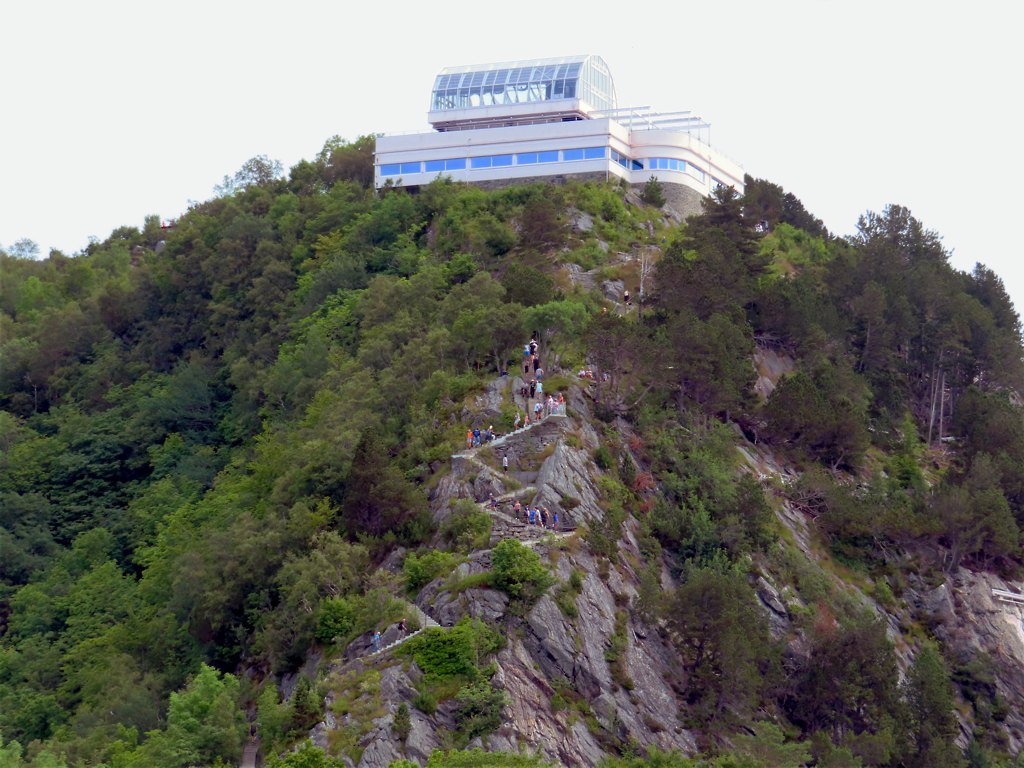
Start at Ålesund Church and move toward Jugendstilsenteret and KUBE before crossing the Brosundet area around Hellebroa. Continue northwest to the Fisheries Museum and Molja, then turn back through Kongens gate toward Byparken. The mapped route finishes with the Aksla climb. Those 418 steps are the day’s real physical work, not an incidental staircase. Skip the summit if steep steps are unsuitable; the central route still works without it. The municipality also warns of rockfall risk on Borgernes veg, so do not treat that path as an automatic alternative.
Day 2: Walk West to Atlanterhavsparken
Walking route
Day 2 — Waterfront west to Atlanterhavsparken
- Apotekertorget
- Steinvågen
- Skarbøvika
- Tuenesvegen
- Atlanterhavsparken
- Tueneset

Begin near Apotekertorget and follow the western waterfront direction through Steinvågen and Skarbøvika toward Tueneset. Atlanterhavsparken places the walk from downtown at about 3.6 kilometers, while Visit Norway estimates roughly 45 minutes. This is a meaningful extension beyond the compact core, not another five-minute museum hop. After the aquarium and Tueneset, use bus 1 from Tuenesvegen if you do not want to repeat the full return walk. The stop is about 10–15 minutes from the aquarium entrance.
When Transit Helps
Walking is usually faster than waiting for a bus inside the compact center. Transit becomes useful when you move west to Hessa or east toward Moa and outer districts. FRAM’s current network lists line 1 between Hessa and Myrland, plus several other city routes through Ålesund. Atlanterhavsparken specifically recommends line 1 toward Hessa and the Tuenesvegen stop. The FRAM app handles journey planning, live departures, and ticket purchase, while the wider Ålesund municipality sits inside the same fare zone.
Arriving in Ålesund Without a Car
Ålesund Airport is straightforward without a rental car. Avinor lists a direct Vy airport coach to the city center for most major flight arrivals and departures. The trip takes about 25 minutes. There is no central railway station, so rail travelers normally connect by regional bus from Åndalsnes or another rail gateway. FRAM currently lists the 681 Ålesund–Vestnes–Åndalsnes service as a train connection. Express boats also reach Ålesund, while cruise passengers usually step ashore beside the central walking zone.
When a Car Becomes Useful
A car adds little to a weekend focused on central Ålesund and Atlanterhavsparken. It becomes more useful for flexible exploration of Giske, Alnes, remote trailheads, or dispersed Sunnmøre viewpoints. Those regional trips were excluded from the city’s walkability score. Buses, express boats, and organized excursions can still cover many out-of-town plans, but their schedules require more coordination than the downtown walking core.
Walking Limitations and Practical Tips
Aksla is the clearest limitation. The viewpoint is close to downtown, yet 418 steps make it a genuine climb for many visitors. Fjord Norway also describes central streets as hilly and partly cobbled. Travelers with reduced mobility should prioritize the flatter Brosundet and harbor streets, then plan Aksla separately. Peak cruise days can crowd the waterfront and popular sights, according to Ålesund municipality. Temporary roadworks and bus diversions were checked during research but were not allowed to change the structural score.
Seasonal Comfort
Coastal weather can change how comfortable the same route feels without changing its underlying walkability. Wet cobbles and the Aksla staircase deserve extra care, while winter daylight shortens the practical sightseeing window. Long summer days make the waterfront and Tueneset easier to combine at a relaxed pace. Weather, scenery, and seasonal atmosphere were kept outside the structural scoring components.
Bottom Line
Ålesund works very well as a car-free weekend because its main waterfront sights form one compact, connected visitor zone. The city is not flat enough to treat every central landmark as equally easy: Aksla’s 418 steps are a substantial effort. Atlanterhavsparken is also far enough west to require a longer walk or bus. Those limitations are predictable, and the bus network provides useful backup without becoming necessary for ordinary downtown sightseeing.