
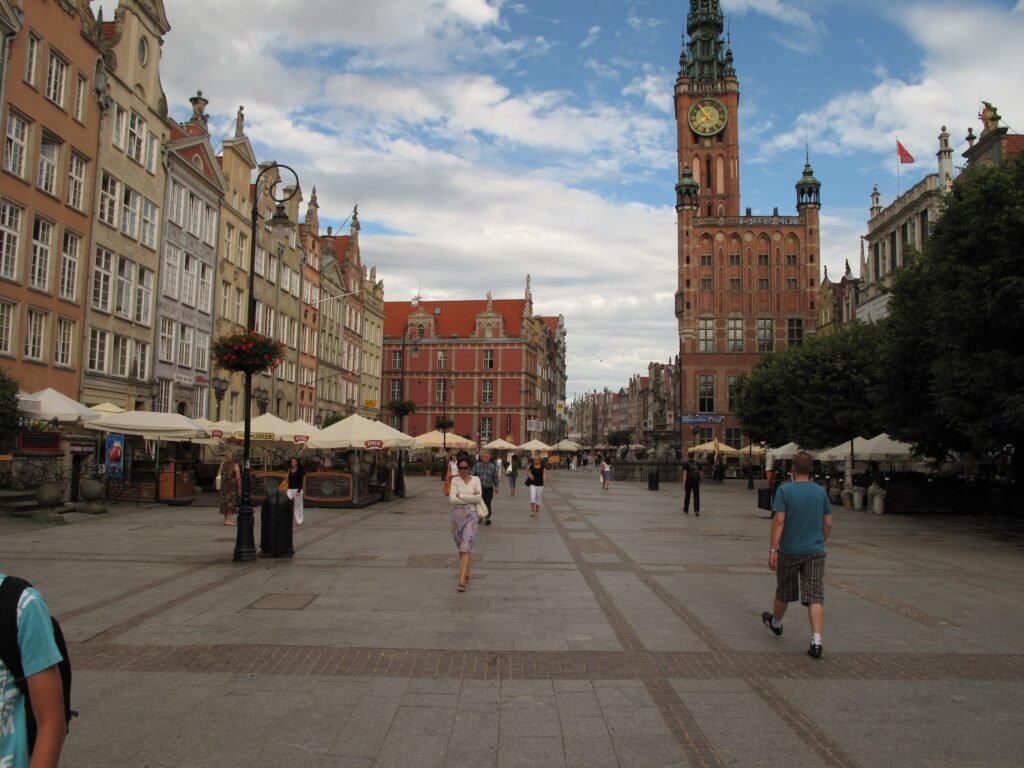
Several of Gdańsk’s defining visitor streets fit inside a compact corridor between Golden Gate and the Motława. From there, permanent bridges pull Granary Island into the same walking system instead of leaving the river as a barrier. Gdańsk Główny sits close enough to join that system, though its tram tracks, main road, and underpass add arrival friction. The geography changes northward, where the Museum of the Second World War and shipyard attractions stretch the sightseeing footprint. Farther destinations such as Westerplatte, Oliwa, and the beaches are better treated as transit-supported extensions. That contrast makes a short stay unusually walkable without pretending the whole city is compact.
Why Gdańsk Works So Well on Foot
The strongest visitor geography begins at Golden Gate and runs straight through Długa and Długi Targ to the Motława. Gdańsk has prohibited ordinary car traffic on Długa and Długi Targ year-round for decades, while Mariacka also carries long-standing motor restrictions. That gives the core genuine pedestrian priority rather than event-only pedestrianization. Main Town Hall, Neptune’s Fountain, St. Mary’s Church and Mariacka all sit close enough that sightseeing time matters more than transfer time.
Gdańsk Główny sits at the western edge of this central walking area. High Gate is roughly a nine-minute walk, and Golden Gate follows shortly after. The station frontage is less comfortable than Main Town because pedestrians negotiate a busy road, tram infrastructure and underpass routing. That friction matters with luggage, but the distance remains short enough for many visitors to walk directly to central hotels.
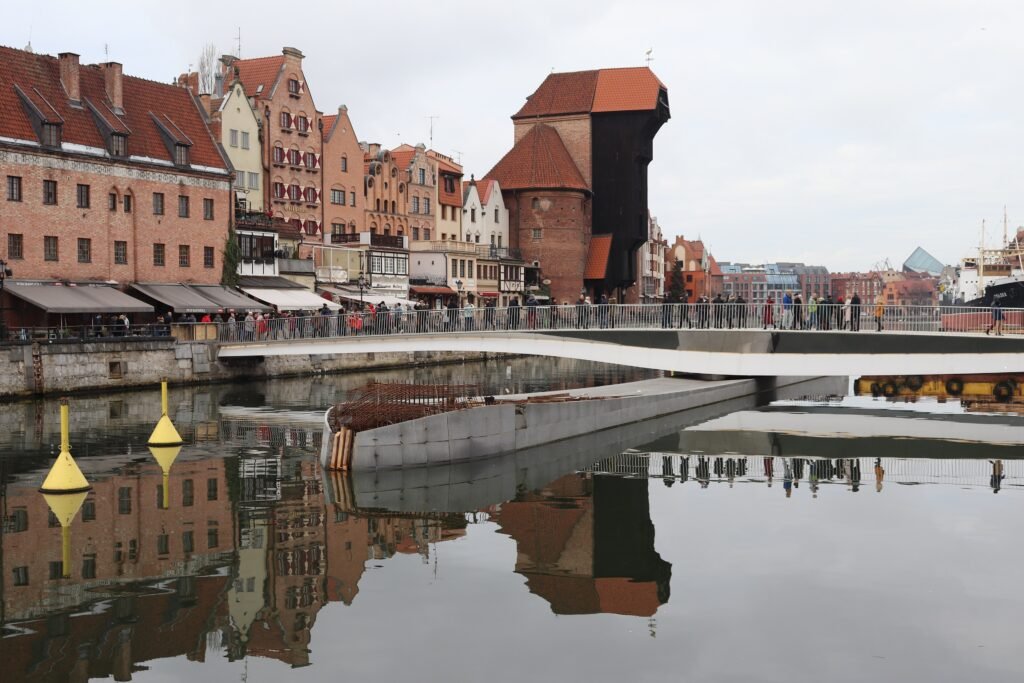
The Motława also creates less separation than the map suggests. Green Bridge and the Św. Ducha footbridge connect Granary Island directly with Main Town, while the Ołowianka footbridge adds another useful crossing. Marine openings can briefly pause individual bridges, but the number of alternatives keeps the waterfront network connected. Granary Island therefore works as a genuine central neighborhood rather than a scenic island requiring transit.
Best Areas to Stay for a Walking Weekend
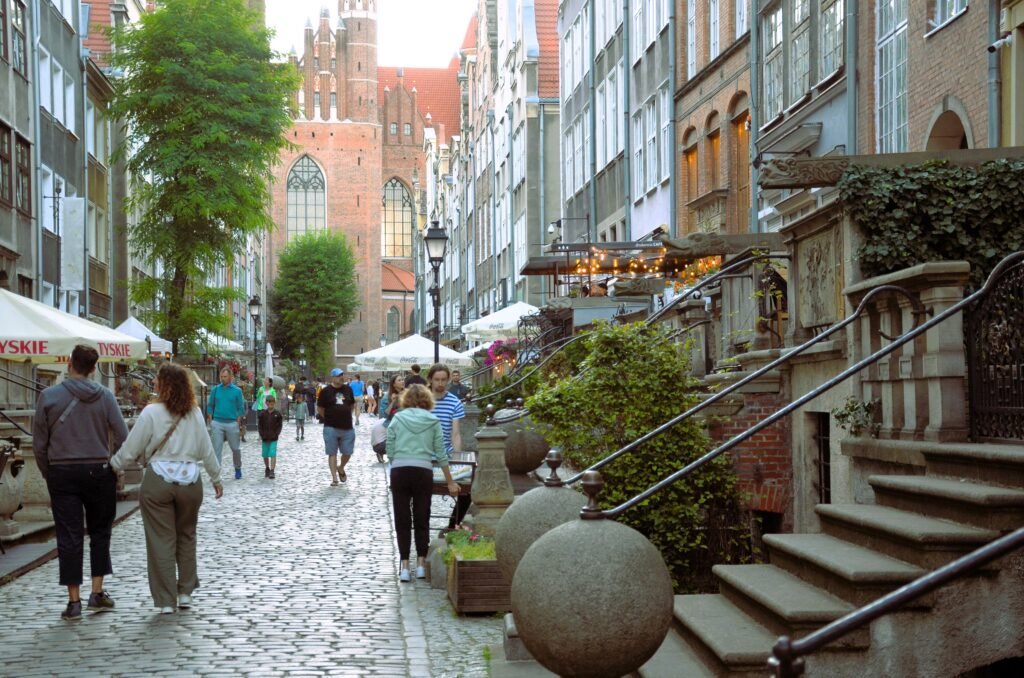
Main Town is the simplest base for a first visit. Długa, Długi Targ, St. Mary’s, Mariacka and the riverfront are all immediately accessible. The tradeoff is historic paving and heavy visitor traffic, especially around Long Market and the waterfront.
Granary Island and the Motława waterfront combine central hotels with immediate bridge access to Main Town. This is especially strong for travelers who want evening river walks without needing a tram home. Waterfront terraces and peak-season foot traffic can make the promenades feel busier than the map suggests.
Gdańsk Główny and the northern central edge work well for rail arrivals and the European Solidarity Centre. Main Town remains close, but the immediate street environment is more traffic- and tram-oriented. Check the exact hotel location before assuming every property marketed as central offers the same walk to Długi Targ.
Useful Walking Times
- Gdańsk Główny to High Gate: about 9–10 minutes. The route is short, but the station frontage adds crossing and underpass friction.
- Gdańsk Główny to Golden Gate: about 10–12 minutes. From here, the pedestrian-priority Royal Way begins.
- Gdańsk Główny to Długi Targ: about 12–15 minutes at visitor pace, depending on the exact crossing route and luggage.
- Golden Gate to Green Gate: about 7–9 minutes along Długa and Długi Targ, before sightseeing stops.
- Długa to the Museum of the Second World War: about 15 minutes. The museum is walkable, but it sits beyond the tightest core.
- Gdańsk Główny to the European Solidarity Centre: about 9 minutes and 700 meters. The official approach includes stairs.
- Museum of the Second World War to the European Solidarity Centre: roughly 16 minutes and 1.4 kilometers.
These are practical planning estimates rather than guaranteed walking times.
A 2-Day Walking Route
The two routes keep each day geographically coherent. The first stays inside the station-to-Main-Town-waterfront system. The second follows the northern museum and shipyard extension, then finishes near the eastern edge of the center. Westerplatte, Oliwa and the beaches remain separate transit-supported options rather than forced additions to either walking map.
Day 1: Gdańsk Główny, Main Town and Granary Island
Walking route
Day 1: Gdańsk Główny, Main Town and Granary Island
- Gdańsk Główny
- Brama Wyżynna (High Gate)
- Golden Gate (Złota Brama)
- Gdańsk Main Town Hall
- Neptune’s Fountain
- Green Gate
- Granary Island (Wyspa Spichrzów)
- Św. Ducha Footbridge
- The Crane (Żuraw)
- Mariacka Street
- St. Mary’s Church
Begin at Gdańsk Główny and walk through High Gate and Golden Gate into the permanent pedestrian core. Follow Długa past Main Town Hall to Neptune’s Fountain and Green Gate. Cross to Granary Island, continue north along the waterfront, then use the Św. Ducha footbridge back toward the Crane. Finish through Mariacka at St. Mary’s Church. This one-way loop shows why the Motława strengthens the central walk instead of splitting it.
Day 2: Solidarity Centre, Shipyard and WWII Museum
Walking route
Day 2: Main Station, Solidarity Centre, Shipyard and WWII Museum
- Gdańsk Główny
- European Solidarity Centre
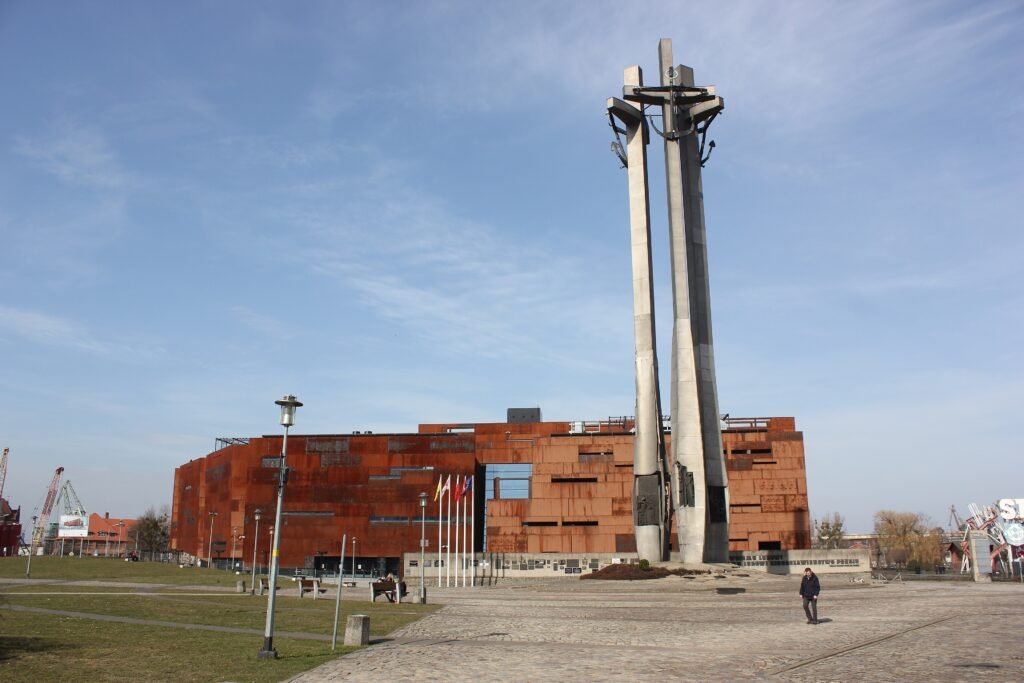
- Monument to the Fallen Shipyard Workers of 1970
- Gate No. 2 of the Gdańsk Shipyard
- BHP Hall of Gdańsk Shipyard
- Imperial Shipyard (Stocznia Cesarska)
- Museum of the Second World War
Start again at Gdańsk Główny, but head north toward the European Solidarity Centre instead of repeating Main Town. Continue through Plac Solidarności, Gate No. 2 and the BHP Hall into the shipyard-edge streets. The environment becomes broader and more industrial here, with less of Main Town’s pedestrian polish. Turn southeast through the Imperial Shipyard area and finish at the Museum of the Second World War. Central accommodation is about a 15-minute walk away.
How Transit Extends the Walking Weekend
Public transport becomes most useful once the itinerary moves beyond Main Town and the central waterfront. Trams and buses connect the center with Oliwa, Brzeźno, Jelitkowo, Westerplatte and other outer destinations, while SKM and regional rail provide useful north–south connections. Sopot and Gdynia remain separate regional outings rather than extensions of a central Gdańsk walk.
FALA, ticket machines and mobile apps provide several ways to pay for local transport. Municipal and rail-inclusive products follow different rules, so check current ZTM, FALA and metropolitan ticket information before travel rather than relying on a fixed fare or assuming one payment method covers every mode.
Weekend and evening public transport remains useful for a short stay, including late services on parts of the network. Outer routes can run less frequently, so check the current timetable before planning Westerplatte, Oliwa or a beach trip.
Arriving Without a Car
Gdańsk Lech Wałęsa Airport has a railway station directly outside the terminal, connected by a covered footbridge. Rail journeys toward the central stations commonly require a change at Gdańsk Wrzeszcz, while direct bus services provide another option into the city. Check current airport, rail and ZTM information before choosing the most convenient route.
Rail arrivals at Gdańsk Główny are easier. The station is already close to the central visitor geography, with High Gate about nine minutes away and Długi Targ roughly 12–15 minutes at visitor pace. The first segment is not fully pedestrianized, but many centrally based travelers can walk straight to their hotel without needing a taxi or local transit.
When a Car Helps
A car adds little to a Main Town and waterfront weekend. Westerplatte, Oliwa, Brzeźno and Jelitkowo all have current public-transport links, so they can be added without driving. A car becomes more useful for regional excursions, remote accommodation or a deliberately dispersed itinerary. Sopot, Gdynia, Malbork and Hel should be planned as separate excursions rather than folded into Gdańsk’s city walking days.
Walking Limitations and Practical Tips
- Historic paving: Mariacka and nearby lanes are attractive but uneven. Cobblestones, raised stoops and narrow clear paths can slow mobility aids and rolling luggage.
- Station approach: the walk is short, yet tram tracks, road crossings and underpass routing make Gdańsk Główny less seamless than the Main Town core.
- Waterfront crowds: the Motława promenades stay connected, but terraces, service activity and peak visitor volumes can reduce walking speed.
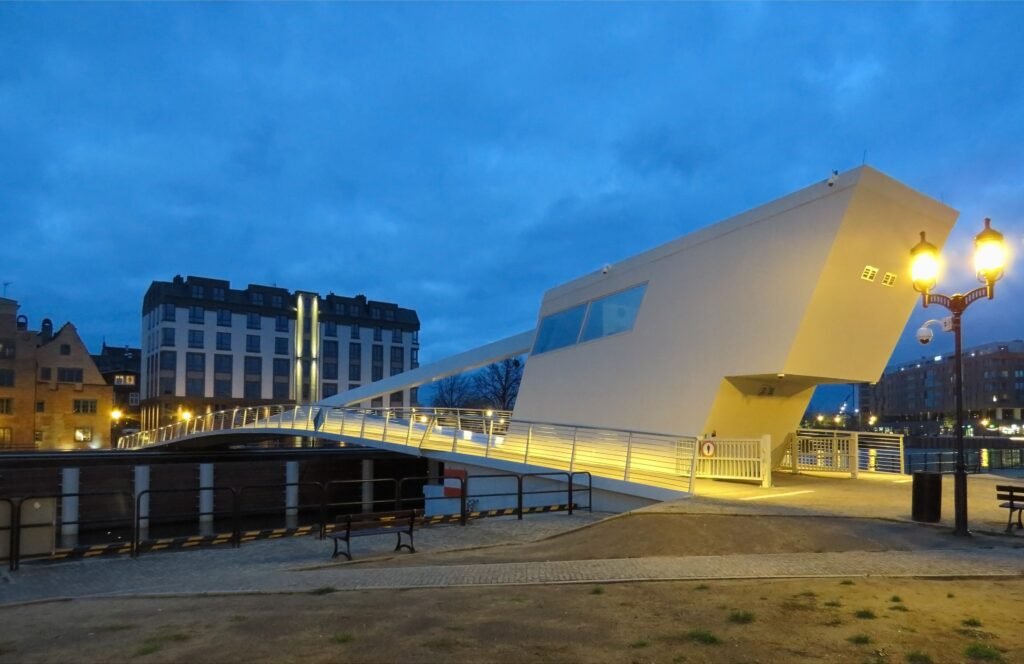
- Bridge operations: the Ołowianka footbridge can pause pedestrian access for marine traffic. Use another central crossing rather than treating the river as blocked.
- Shipyard edge: expect larger roads, industrial parcels and occasional stairs north of the core. Conditions differ noticeably from Długa or Długi Targ.
- Accessibility around the station and shipyard area can change when lifts, bridges or nearby infrastructure are under maintenance. Check current local access information if step-free routing is important.
Seasonal Walking Note
Gdańsk’s compact central distances remain useful year-round, but comfort changes with Baltic weather. Wind, rain, winter ice and occasional snow can make exposed waterfront sections or cobbles more tiring, while summer crowds can slow the Motława and Długi Targ. These conditions change comfort rather than the distances and connections between the main sights.
Bottom Line
Gdańsk’s strongest visitor experience is a compact station-to-Main-Town-to-waterfront walk, supported by direct bridges and central lodging. The Museum of the Second World War and shipyard sites extend that footprint without breaking a two-day walking plan. Transit becomes important for Westerplatte, Oliwa and the coast, while a private car is unnecessary for the standard short stay.